Not in a shadowed hallway. Not by accident after too much champagne. She did it on the raised wooden stage, under the harsh white glare of theatrical lights, inside a sprawling oceanfront estate in Newport, Rhode Island, while hundreds of wealthy guests looked on.
The wig fell to the polished floor like something lifeless.
And standing there, frozen before all those silk gowns, tailored suits, diamond necklaces, and cruel smiles, was my wife, Elaine—a woman who had spent the last six months fighting stage three ovarian cancer with every ounce of strength her body had left.
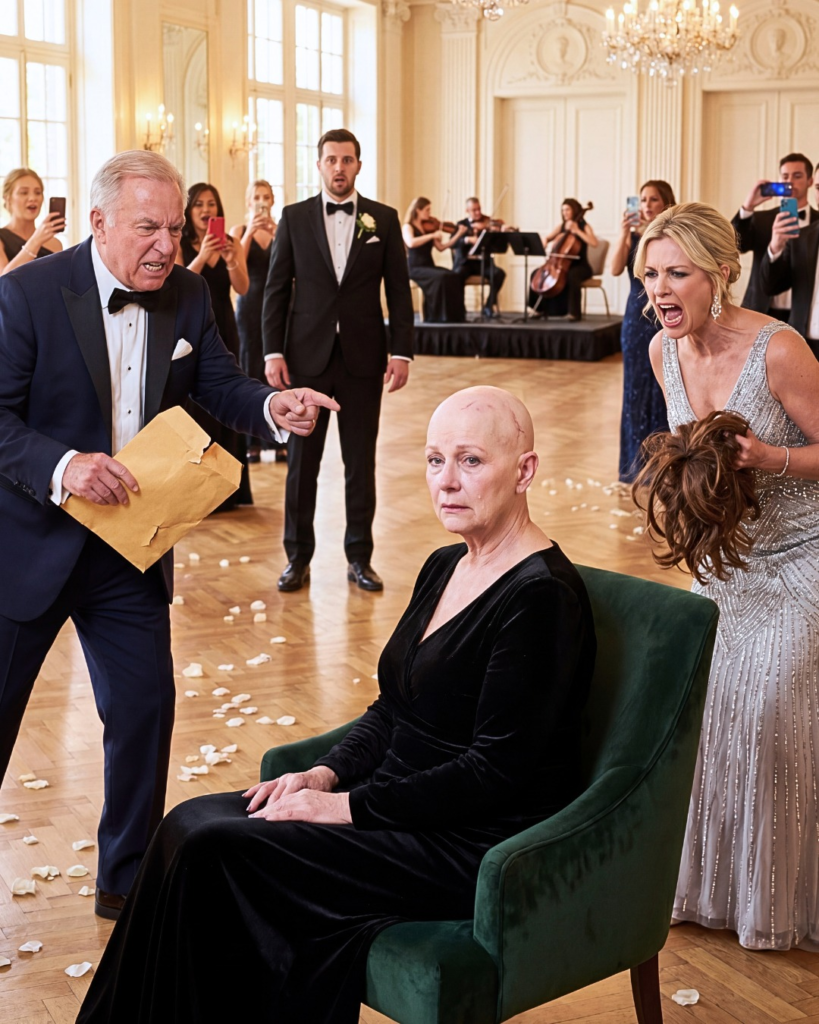
What still haunts me most about that moment is not the scattered laughter that rolled through the room.
It was my son’s silence.
But to understand how a family can break in public, you need to know what happened before Elaine ever climbed onto that stage.
That afternoon, we arrived at the estate just as the ocean wind was pushing salt air across the stone driveway. The property looked like something built to impress people who were already impossible to impress—glass walls facing the Atlantic, white orchids dripping from every archway, Belgian linen on every table, crystal glasses refilled by silent servers who moved like ghosts.
I had served in the United States military for almost forty years and retired as a colonel. I had stood through ceremonies at the Pentagon and Arlington, surrounded by protocol, discipline, and power. But standing there at my own son’s wedding, I felt like an intruder.
Elaine walked beside me with her fingers resting lightly on my forearm. The chemotherapy had weakened her balance and burned the nerves in her feet, but she refused to lean on me like she was helpless. She moved carefully, proudly, every step deliberate.
That morning, in the small bathroom of our hotel, she had spent nearly an hour fixing her wig.
“I don’t want Caleb worrying about me today,” she had whispered when I suggested we sit somewhere quiet in the back.
The wig was dark brown, cut into a neat bob, almost exactly like the hair she had before the treatments took it from her. To anyone else, it looked ordinary. But I knew what it cost her. I knew how many mornings she had forced herself out of bed, dizzy and nauseated, just to practice walking with her chin up. I knew how badly she wanted to look like herself when her son saw her.
That was Elaine. She hated the idea of her pain becoming someone else’s burden.
At the entrance, a young hostess with a leather clipboard glanced at my navy suit, then at Elaine’s modest blue dress.
“And you are?” she asked.
“Mitchell,” I said. “The groom’s father.”
Her smile flickered before returning with artificial warmth. “Of course. Right this way, sir.”
She led us to the front row, but her manner made it clear we were there because biology required it, not because anyone truly wanted us close.
I scanned the room. Vanessa’s family had arrived in full force. Men in custom suits checked their watches. Women in silk laughed with sharp, effortless confidence. It was the sound of people who believed the world had been waiting for them since birth.
Vanessa stood near the stage in a white designer gown that caught the light so aggressively it almost hurt to look at her. When Caleb approached, she gripped his arm—not lovingly, but possessively, as if displaying something expensive she had just acquired.
Then Caleb saw us.
For one second, his eyes landed on Elaine.
He nodded.
That was all.
No hug. No smile. No crossing the room to take his mother’s hand. No asking if the travel had exhausted her.
Elaine lowered herself carefully into her chair and smoothed her dress. “It’s beautiful, Robert,” she whispered, looking out at the water.
I knew what she was doing. She was forcing herself to focus on the venue instead of the coldness of our welcome.
Behind us, a group of women began speaking in voices loud enough to be heard.
“I heard the groom’s mother has been very ill,” one said.
“Yes,” another replied. “Cancer, I believe. Honestly, I’m surprised they let her attend. Weddings like this need a certain atmosphere. It’s depressing.”
A few women laughed softly.
I didn’t need to turn around. I knew the voice belonged to Diane, Vanessa’s mother.
Elaine heard every word. Her fingers tightened in her lap until her knuckles turned white. Then, slowly, she relaxed them and touched the edge of her wig.
“I’m fine, Robert,” she said, still staring at the ocean.
Across the room, Vanessa leaned close to one of her bridesmaids, who whispered something while looking directly at us. Vanessa’s eyes moved through the crowd and settled on Elaine’s hair.
She stared too long.
Then she smiled.
It was not friendly. It was the smile of someone discovering a weakness she could use later.
The ceremony began twenty minutes later. A string quartet played near the garden. Guests settled into velvet chairs. Vanessa walked down the aisle like royalty entering a court. Caleb stood waiting beside the officiant, smiling nervously.
Elaine watched him with such tenderness that it nearly broke me. For a moment, in the afternoon light, I could see the woman she used to be before the hospital rooms, before the nausea, before the brutal math of survival.
The vows were short. Promises were exchanged. Applause rose. Champagne appeared instantly.
Then came the reception.
Tables covered the wide teak balcony overlooking the Atlantic. The sunset stained the sky purple and gold, making the whole world look perfect if you didn’t know where to look for cracks.
I knew where to look.
Vanessa and her family moved from table to table like conquerors. Caleb followed half a step behind them, laughing too loudly, trying too hard, desperate to belong.
Almost no one came to Elaine. A few guests nodded politely, then quickly looked away, as if illness were contagious.
Every few minutes, Elaine lifted one hand to the back of her neck, checking the wig. It wasn’t slipping. I knew the gesture. She did it when she was exhausted and trying not to show it.
“I’m going to talk to Caleb,” I said, pushing my chair back.
Elaine touched my wrist. “Robert, please. Don’t make things difficult for him today.”
Even then, she was protecting him.
“I’ll only be a minute.”
I found Caleb near the bar with three of Vanessa’s groomsmen. They were drinking expensive whiskey and laughing like boys who had never been told no.
“Caleb,” I said.
He turned, startled. “Dad.”
“Your mother is exhausted,” I said quietly. “Come sit with her for ten minutes.”