Judge Judy met me at the door, older now, slower, still angry at the universe. I fed him. Made coffee. Walked down the hall.
Lily’s door was open.
Morning light lay across the floor.
On the desk was her letter.
On the wall was a copy of her painting.
On the shelf was a photograph of her laughing under birthday lights.
I stood there for a long time.
Then I knocked on the open door.
Once.
Softly.
Habit.
Love.
Madness.
Prayer.
No one answered.
No one ever would.
I stepped inside anyway and opened the curtains wider.
Because I had promised.
Because she had asked me not to close the door.
Because once, my daughter screamed inside a house and no one listened soon enough.
Because once, she survived.
Because once, she laughed.
Because once, morning light touched her face, and she called me Dad.
The house was quiet.
This time, I was afraid.
But I stayed.
That was all I had left to give her.
So I stayed in the quiet, with the door open, waiting for a voice I would never hear again.
And somewhere beyond every wall I could not break through, beyond every road I could not turn back, beyond every morning that arrived without her permission, my Lily was gone.
The light remained.
But my daughter did not.
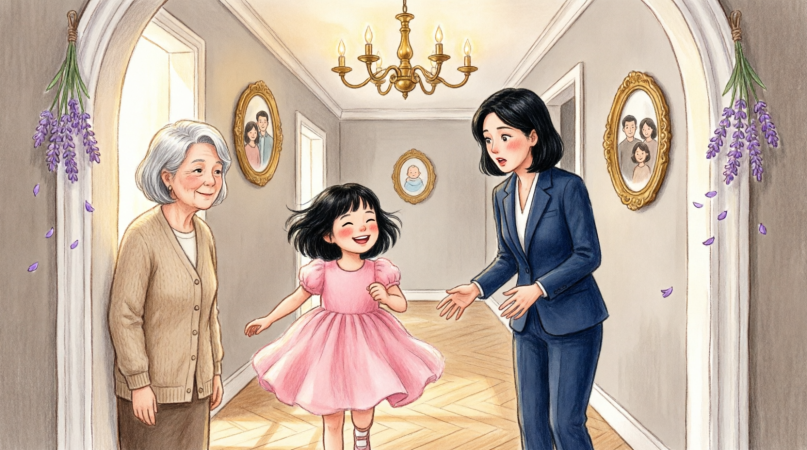
For five years, I kept Lily’s door open.
Not halfway.
Not just a crack.
Open.
Every morning, before coffee, before work, before Judge Judy screamed at me from the hallway like a tiny orange landlord, I walked to my daughter’s yellow room and opened the curtains.
Sometimes the sun came in bright.
Sometimes rain grayed the glass.
Sometimes dust floated in the light like the room itself was breathing.
I would stand there for a minute.
Not praying exactly.
Not talking, not always.
Just standing.
A father keeping a promise to a daughter who had asked him, with her last breath, not to close the door.
People called it grief.
Therapists called it ritual.
Mrs. Alvarez called it love.
Maybe it was all three.
But on the morning the envelope came, it felt like the room was waiting for me.
I found it in the mailbox between a grocery flyer and a water bill.
Official state seal.
Department of Corrections.
My name typed neatly across the front.
Michael Torres.
I knew before I opened it.
My hands knew.
My stomach knew.
Some bad news has a smell, even through paper.
I stood in the driveway with the sun hitting my face and the envelope trembling between my fingers.
Mrs. Alvarez was watering her roses across the street. She saw me stop moving.
“Michael?” she called.
I didn’t answer.
I tore the envelope open.
The first sentence blurred.
Then the words sharpened.
Maria Torres has petitioned for a sentence reduction hearing.
For a moment, I was back in that bedroom.
The broken phone.
Lily on the bed.
Maria in the doorway saying, “What did you do?”
Not “Is she okay?”
Not “My baby.”
What did you do?
I folded the letter once.
Then again.
Too carefully.
Like if I made the paper small enough, the past would stay small too.
It didn’t.
Mrs. Alvarez crossed the street in her slippers, water still dripping from the hose behind her.
“What is it?”
I handed her the letter.
She read it once.
Her face hardened in a way I had seen only a few times.
“She wants out?”
“She wants less time.”
“That woman wants many things.”
I laughed once.
It was empty.
“Apparently good behavior. Cooperation. Rehabilitation.”
Mrs. Alvarez looked at me over the top of the page.
“And what do you want?”
I looked toward my house.
Toward the yellow room.
Toward the door that had stayed open all these years.
“I don’t know.”
She folded the letter and handed it back.
“Yes, you do.”
I wanted to say I wanted Maria to rot.
I wanted to say I wanted Dr. Keller and Eric Vance and the drunk driver and every person who had ever looked away from my daughter’s pain to wake up every morning with the kind of grief that chewed bone.
I wanted to say I wanted five minutes alone with all of them.
But Lily’s letter lived in my shirt drawer.
Please be happy someday.
Not instead of missing me.
Just with it.
So I said the truth.
“I want it to be over.”
Mrs. Alvarez’s eyes softened.
“Then maybe this is the last door.”
I hated that word.
Door.
Everything in our lives had become a door.
The closet door I opened too late.
The bedroom door Lily begged me not to close.
The courtroom doors.
The hospital door.
The dorm room door.
The yellow door.
The one I kept open because it was the only thing left I could obey.
I looked at the letter again.
The hearing was in three weeks.
Three weeks.
Long enough for dread to unpack its bags.
Short enough that I couldn’t pretend it was far away.
That night, I called Daniel.
He answered on the second ring.
“Please tell me Judge Judy finally learned manners.”
“Maria filed for a sentence reduction.”
Silence.
Then a chair scraped on his end.
“When?”
“Three weeks.”
“She can do that?”
“Apparently.”
Daniel exhaled hard.
“What are you going to do?”
“I don’t know.”
“That means you know and you hate it.”
I closed my eyes.
My little brother had become annoyingly wise after surviving our worst years beside us.
“I don’t want to see her,” I said.
“Then don’t.”
“I don’t want her thinking silence means forgiveness.”
“Then speak.”
“I don’t want to spend one more second of my life inside what she did.”
Daniel was quiet.
Then he said, “Mike, you won’t be speaking for what she did. You’ll be speaking for who Lily was.”
That sentence stayed with me.
For two days, I carried it around like a stone in my pocket.
Then I drove to Tucson.
Not for the hearing.
Not yet.
I drove to the Lily Torres Art Room.
The children’s advocacy center had grown since Lily first volunteered there. A new wing had been added after a fundraising campaign I had tried to avoid and somehow ended up leading. There was now a small garden out back, a therapy dog named Waffles, and a mural painted along the hallway.
The mural showed a desert, a blue ocean, and a door standing open between them.
Lily’s door.
Her painting had become something larger than canvas.
I stood in front of it with my hands in my pockets.
A woman’s voice behind me said, “She still brings people in.”
I turned.
Maya Reynolds, the center director, walked toward me holding a stack of folders. She was in her early fifties, with silver-streaked hair, tired eyes, and the kind of calm that came from years of helping children carry impossible stories.
“Morning, Michael.”
“Morning.”
She looked at the mural.
“Rough week?”
I almost smiled.
“You read faces for a living?”
“Children’s faces mostly. Adults are easier. They pretend less convincingly.”
I handed her the letter.
She read it without interrupting.
Then she lowered the page.
“Are you going?”
“I don’t know.”
Maya didn’t give me advice right away.
I respected her for that.
She walked with me into the art room.
It was empty at that hour. Small tables. Stacks of construction paper. Washable paint. Crayons. A shelf of clay. Aprons hanging from hooks. On one wall, in simple black letters, were Lily’s words from her statement:
Shame belongs to the people who hurt you.
I had objected to putting her words on the wall at first.
It felt too public.
Too raw.
Then a twelve-year-old girl saw the sentence during opening week, stood still for almost a full minute, and whispered, “Can I write that down?”
After that, I stopped objecting.
Maya set the folders down.
“You know what I think?” she asked.
“What?”
“I think closure is usually a word people use when they want grief to behave.”
I looked at her.
She shrugged.
“I don’t believe in closure. Not the way people sell it. The door doesn’t close. You don’t stop loving them. You don’t stop remembering the before and after.”
“That’s comforting,” I said dryly.
She smiled a little.
“I believe in completion.”
“What’s the difference?”
“Closure says, ‘This no longer hurts.’ Completion says, ‘This no longer controls the whole room.’”
I looked around the art room.
Yellow paper suns hung from the ceiling. Each one had been made by a child. Some were neat. Some were wild. Some were angry black circles with yellow lines stabbing outward.
All of them were still suns.
Maya said, “Maybe this hearing is not about Maria. Maybe it’s about you deciding she doesn’t get the whole room anymore.”
I turned away because my eyes had started to burn.
“I’m tired.”
“I know.”
“I was tired before Lily died. I’ve been tired since.”
“I know.”
“I don’t want to be brave.”
Maya stepped beside me.
“Then don’t be brave. Be honest.”
That was what I did.
For the next three weeks, I wrote.
Not a speech.
Not at first.
I wrote memories.
Lily at three, asleep on my chest during a thunderstorm.
Lily at seven, putting stickers on my hard hat.
Lily at ten, making the paper crown.
Lily at fifteen, whispering, “Please don’t let Mom talk to me alone.”
Lily at eighteen, laughing under string lights.
Lily in the hospital, asking me not to close the door.
I wrote until my hand cramped.