
But at 3 a.m.
I received a message from my father: “My daughter, it’s me.
Dad
Come to the cemetery immediately and very quietly.”
Even now, when I replay that night in my head, that is the sentence that still makes my skin go cold.
My father, Thomas Carter, died on a Thursday afternoon after years of heart failure.
|Not the dramatic kind people picture in movies.
His illness was slower, crueler, and somehow more exhausting.
It took his breath first, then his strength, then his ability to hide how frightened he really was.
By the time he died, every room in my parents’ house held some trace of the battle: pill organizers on the counter, oxygen tubing by his chair, hospital paperwork stacked in neat piles because my father hated mess even when he was sick.
I was his only daughter.
He used to call me Missy when I was little and Melissa whenever he wanted me to know he was being serious.
He was the one who taught me to change a tire, balance a checkbook, and spot the difference between confidence and charm.
Looking back, that last lesson might have saved me if I had remembered it sooner.
My husband, Andrew, had been all charm when we met.
He knew how to smile at waitresses, how to speak softly to strangers, how to make every selfish instinct sound like ambition.
For the first two years of our marriage, I mistook calculation for stability.
By the fourth year, I knew he was colder than he wanted the world to believe, but I kept explaining him away.
Stress from work.
Pressure.
Money worries.
The usual excuses women make when they are not ready to admit that the person beside them is not confused or damaged or temporarily distant.
He is simply showing you who he is.
My father saw Andrew more clearly than I did.
He never pushed me to leave him.
That wasn’t his style.
But during his last month in the hospital, when Andrew thought I was out getting coffee, my father took my hand and asked me a strange question.
Has he always watched people’s money the way he watches mine?
I laughed at the time because it sounded petty, almost paranoid.
Andrew had been handling some of the insurance calls, helping organize bills, talking to doctors with me.
I thought my father was embarrassed by needing help.
Now I know he was warning me in the only way he could without starting a war at his bedside.
At the funeral, Andrew’s mask slipped in a way I could never unsee.
My father had been buried less than half an hour when Andrew leaned down and murmured that he had business to handle.
He didn’t squeeze my hand.
He didn’t ask if I wanted him to stay.
He simply left.
That night my cousin Jenna called by accident while trying to reach someone else, and in the middle of apologizing she let something slip.
She had seen Andrew at the airport with a blonde woman in medical scrubs under a coat.
Not work clothes, she said.
More like someone trying to cover what she was wearing.
I asked her to describe the woman, and by
the time she mentioned the sharp bob haircut and the silver badge clip on her purse, I felt physically sick.
Kendra Walsh.
My father’s hospice nurse.
I didn’t even cry then.
I was too stunned.
I just sat on the edge of my childhood bed in my funeral dress, numb with a kind of humiliation so deep it seemed to hollow out my bones.
My father was gone.
My husband had left me hours after the burial.
And the woman he left with was one of the last people trusted to care for my father.
My mother, Elaine, finally cried herself to sleep in the next room.
I stayed awake under the old glow-in-the-dark stars that were still stuck to my ceiling from high school.
It was almost funny, in a bitter way.
I was thirty-four years old, grieving like a child, abandoned by my husband, and back in the room where my father once sat beside me after nightmares.
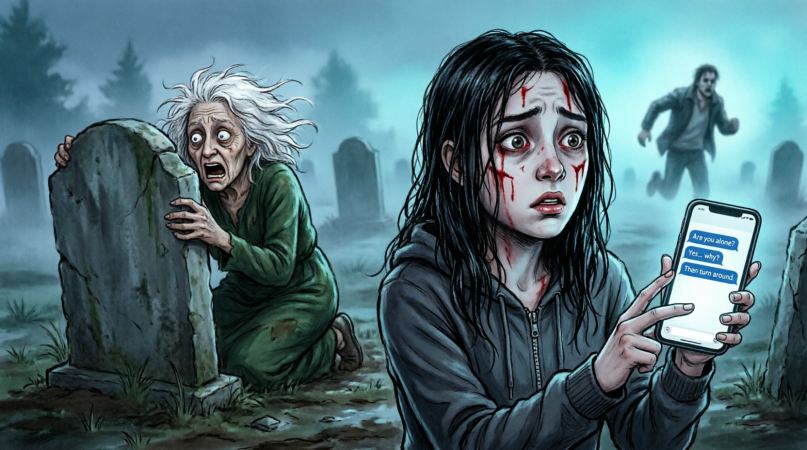
Then my phone buzzed at 3 a.m.
The message came from an unknown number.
My daughter, it’s me.
Don’t panic.
Come to the cemetery immediately and very quietly.
I need you.
It used my father’s voice so perfectly that it felt like someone had reached into my chest and squeezed.
Come very quietly was his phrase.
He had used it for private talks my entire life.
Only someone close to him would know that.
I left without waking my mother.
I did not call the police because I was not thinking like a careful person.
I was thinking like a daughter whose dead father had just spoken in the language only he used with her.
The cemetery was almost empty, washed in weak yellow light.
My father’s phone was propped against his gravestone, screen glowing.
Fresh footprints marked the wet soil.
Before I could decide whether to grab the phone or run, Walter Boone, the cemetery caretaker, stepped from the shadows and said my father had asked him to do this.
Boone handed me an envelope with my name written in my father’s handwriting.
My father, he explained, had visited the cemetery weeks earlier and left instructions.
If Andrew abandoned the funeral early, Boone was to place the phone on the grave after midnight and wait nearby in case I came alone.
Inside the envelope, my father had written: If Andrew leaves before the condolences are over, stop trusting what you think you know.
Start with the phone.
Then go to the red toolbox in my workshop.
Do not tell your mother yet.
The phone unlocked with my birthday.
One audio file was waiting.
My father’s voice was weak but steady.
He said Andrew was not only unfaithful.
He was lying about money, pressing him to sign documents, and showing far too much interest in his medications.
My father had changed his will on Monday.
Andrew found out.
That, my father said, was why Andrew had suddenly become desperate.
He told me there was a key and a memory card hidden in the red toolbox in the workshop and instructed me to get to First National Bank, box 214, as soon as it opened.
Then came the line that changed everything.
If the man in the next video is who I think it is, Andrew didn’t do this alone.
drove back to the house on autopilot, my pulse hammering so hard I could feel it behind my eyes.
In the workshop, exactly where my father said it would be, I found a brass key, a memory card, and another note: Watch the video before you trust anyone.
I put the memory card into my laptop.
The first file showed my father’s bedroom from a hidden angle near the bookshelf.
The timestamp was two nights before he died.
Andrew walked in, opened the medication drawer, and switched one pill bottle for another.
Then he called someone and said, We just need one more day.
After the funeral, we disappear.
The second file made my stomach drop.
Kendra walked in wearing scrubs.
She went straight to Andrew, took a set of papers from him, and said, He won’t sign anything if Melissa is here.
You said she’d be gone tonight.
Andrew answered, She was.
Her father called, and she ran back.
She always runs back for him.
Then he kissed her.
The third file was audio only, but I knew the male voice within seconds.
Victor Hale, my father’s attorney.
If Thomas changed the will, Victor said, we need the original before probate.
Once Andrew gets Melissa to sign, the house and the business can still be moved.
I remember staring at the dark laptop screen after the file ended, hearing my own breathing and nothing else.
My husband.
My father’s nurse.
My father’s attorney.
All working angles around a dying man.
Then headlights swept across the workshop window.
I nearly screamed, but it was only my mother’s friend Lorraine dropping off a casserole dish she had forgotten earlier.
I let her go without opening the door and locked every entrance in the house.
The fear had changed shape by then.
It was no longer the wild fear of the cemetery.
It was focused, intelligent fear.
The kind my father had meant when he wrote that it could point me toward the truth.
At 6 a.m., I finally woke my mother.
I did not show her everything at once.
I could barely hold myself together, and she had buried her husband the day before.
I only told her Andrew had lied about where he went and that Dad had left instructions for me because he suspected fraud.
She looked at me for a long, silent moment and then said something that still hurts to remember.
Your father told me last week that he was worried you were too loyal to a man who had not earned it.
She did not cry.
She only sat down, folded her hands, and said, Then let’s not waste his last good warning.
My father had anticipated that I would need one person I could trust, so tucked inside the toolbox note was a business card with a name written on the back: Elena Park.
Elena had been my father’s accountant for years.
More importantly, she had once been his student employee at the hardware store when she was in college.
She arrived at the house an hour later, still in sneakers, hair tied up, carrying a legal pad and a look on her face that told me Dad had already prepared her for the possibility that something ugly would surface.
He called me Monday night,
she said.
He told me if you contacted me before the bank opened, I was to go with you and not let you walk into that building alone.
At 9 a.m., Elena and I opened safe deposit box 214.
Inside was my father’s real will, stamped and witnessed.
There was also a thick envelope of documents: bank statements, screenshots, copies of forged signatures, property transfer drafts Andrew had prepared without my knowledge, and printed travel reservations for Andrew and Kendra to leave the country the morning after the funeral.
My father had even included a written affidavit explaining why he had secretly installed the camera in his bedroom.
He suspected Andrew and Kendra were manipulating medication times to keep him sedated, then presenting papers when he was confused or exhausted.
There was one more item in the box: a small digital recorder.
On it, my father had preserved a conversation with Victor Hale from three days before he died.
Victor urged him to sign an asset transfer while Andrew waited outside.
My father refused.
Victor’s voice, usually polished and warm, turned sharp.
He warned that delays would create complications for the family.
My father replied, very clearly, The only complication here is that my son-in-law thinks I’m too weak to notice he’s trying to steal from my daughter.
We took everything directly to Detective Sofia Ramos, who had handled elder fraud cases before.
She watched the bedroom footage twice, listened to the recordings, and called in two more officers.
By noon, the case had gone from family suspicion to formal investigation.
The hardest part was what Ramos could and could not promise.
The medical examiner had already certified my father’s death as heart failure.
Proving that medication tampering caused or hastened it would be complicated.
But tampering itself, fraud, conspiracy, and attempted theft were still serious.
Victor could lose everything.
Kendra could lose her license and face charges.
Andrew could face prison.
That should have felt like relief.
Instead I felt something colder.
I had married a man who had looked my father in the face while planning to profit from his decline.
Detective Ramos asked whether Andrew knew I had access to the bank box.
I shook my head.
Good, she said.
Then let’s keep it that way for a few more hours.
The plan was simple.
I would text Andrew and say I had found a key in Dad’s workshop and was confused by some paperwork in a bank envelope.
Nothing more.
If he was guilty, he would come back for the documents.
He responded in less than a minute.
Don’t do anything until I get there.
He was supposedly in Miami.
Two hours later, he was in my parents’ driveway.
That told me all I needed to know about how important whatever he wanted really was.
Detective Ramos and another officer waited in an unmarked car down the street.
Elena stayed in the kitchen with my mother.
I sat alone in the living room where my father used to watch baseball, the envelope of copied documents on the coffee table in front of me.
When Andrew walked in, he was dressed in the same suit from the funeral, but his tie was gone and his collar was open.
He looked tired, irritated, and strangely eager.
He tried
for concern first.
Melissa, I heard you were upset.
I came straight back.
You came straight back from your mistress? I asked.
He froze only for a second.
Then his face hardened.
This is not the time for drama.
I almost laughed.
My father had been buried the day before, and he was lecturing me about timing.
I picked up the brass key from the table.
Andrew’s eyes moved to it instantly.
Dad left this, I said.
And some papers.
I don’t understand why your name is on drafts transferring his store shares.
Andrew sat down slowly.
I could see him thinking, adjusting, calculating the lie that had the best chance of landing.
Thomas was confused near the end, he said.
He wanted help structuring things.
I was handling it for you.
For me?
Yes.
To protect you.
I slid a printed still frame from the camera footage across the table.
It showed him at my father’s medication drawer.
Protect me from what, Andrew?
The color left his face.
He looked toward the hallway, then back at me
Where did you get that?
Another photo.
Him kissing Kendra in my father’s room.
Then a transcript of Victor’s audio.
His voice changed.
The soft husband tone disappeared, and something impatient and ugly rose up beneath it.
You don’t understand what you’re looking at.
Then explain it.
He stood so quickly the chair legs scraped the floor.
He pointed at the papers like they offended him.
Your father was dying anyway.
He kept delaying everything.
He said he wanted to review terms, then changed his mind, then changed the will.
Do you know what that did to the deal?
The deal.
That was what he called my father’s life.
I said, You switched his medication.
Andrew dragged both hands over his face.
And that was the moment he made the mistake that finally ended him.
I didn’t poison him, he snapped.
I lowered a dose so he’d be awake enough to sign when Victor came back.
Kendra said it wouldn’t hurt him.
He was already failing.
There are confessions that sound loud even when they are spoken in an ordinary voice.
That was one of them.
The front door opened behind him.
Detective Ramos stepped inside and said, Andrew Walker, don’t move.
He turned so fast I thought he might run, but there was nowhere to go.
Another officer entered from the back.
My mother stood at the kitchen doorway, one hand over her mouth, Elena beside her.
Andrew looked at me as if he still couldn’t believe I had done this.
You set me up, he said.
No, I answered.
My father did.
Kendra was arrested that evening at an airport hotel.
Victor Hale was taken from his office before sunset.
Over the next several weeks, investigators uncovered everything my father had suspected and more.
Andrew had opened credit lines using my information, moved money from a joint savings account into shell entities Victor helped create, and prepared fraudulent transfer documents tied to my father’s hardware store and the family home.
Kendra had altered medication logs and accessed my father’s medical chart without authorization.
Victor had drafted papers meant to survive just long enough to move assets before probate caught them.
The hardest truth was also the murkiest one.
The medical
examiner could not prove beyond doubt that the lowered dose caused my father’s death.
His heart had been weak for years.
But the state did not need a murder charge to bury Andrew’s future.
Fraud, conspiracy, elder exploitation, tampering with medication, attempted theft, identity-related charges, and professional misconduct were enough.
Victor was disbarred.
Kendra lost her license and faced criminal charges.
Andrew’s bail conditions included surrendering his passport.
The trip he had planned after my father’s funeral ended in a county holding cell.
I filed for divorce before the month ended.
Because my father had changed his will and moved key assets into a trust managed independently, Andrew got nothing
Not the house.
Not the store.
Not the investments he had spent months circling like a vulture waiting for the right moment to descend.
I wish I could say justice felt clean.
It didn’t.
It felt necessary.
My mother carried the guilt of not seeing it sooner.
I carried the guilt of bringing Andrew into our family at all.
Elena reminded us, more than once, that predators succeed because they study decency and wear it like a costume.
My father, even as sick as he was, had seen through the costume before either of us did.
A few weeks after the arrests, I went back to the cemetery alone in the early evening.
Walter Boone was trimming hedges near the gate.
He nodded when he saw me, then gave me privacy.
The grave still looked too new.
The grass had not settled.
The stone felt colder than the air.
I stood there with my hands in my coat pockets and thought about the last gift my father had given me.
Not money.
Not property.
Not even protection, though he gave me that too.
He gave me proof.
He gave me the truth when the lie around me was at its most convincing.
I read his final letter again, the one found in the bank box after the investigators took what they needed.
In it he wrote that love without honesty turns into a trap, and that the most dangerous people are often the ones who know exactly how much grace you are willing to extend.
He ended with a line that broke me all over again.
You were never too soft, Melissa.
You were simply loving in the presence of someone who treated love like an opening.
I cried then, finally and fully, the way I had not allowed myself to cry during the funeral or the night at the cemetery or the arrest.
When the tears passed, I touched the stone, whispered thank you, and stood there until the sky turned the color of old bruises.
People later asked me what the biggest red flag had been.
Andrew leaving the funeral.
The affair.
The money.
The fake concern.
The answer changed depending on the day.
But deep down I think the worst part was not the betrayal itself.
It was realizing how long I had been training myself to explain away the chill in him because admitting the truth would have shattered the life I thought I had.
My father’s death was the worst thing that ever happened to me.
But the truth he set in motion before he died saved what was left of my life.
And even
now, when I think about forgiveness, I do not wonder whether Andrew deserves it.
I wonder something harder: how many women mistake endurance for loyalty, and how many signs do they swallow before one terrible night forces them to see exactly who has been standing beside them all along?
The Woman Who Came After the Arrest
The first week after Andrew was arrested did not feel like justice.
It felt like living inside the wreckage after a storm.
Everyone kept telling me I was safe now.
Detective Ramos said it.
Elena said it.
My mother said it while holding both my hands across the kitchen table.
Even Walter Boone said it at the cemetery, standing near my father’s grave with his hat pressed against his chest.
But safety is not a light switch.
You do not go from terror to peace in one clean motion.
You carry the fear with you.
Into the grocery store.
Into the shower.
Into bed.
Into the silence after midnight when every small sound becomes a warning.
Andrew was in custody.
Kendra had been arrested at the airport hotel.
Victor Hale had been dragged out of his polished office before sunset.
My father’s evidence had worked exactly the way he planned.
But I still woke every night at 3 a.m.
The same time the message came.
The same time my dead father reached through the dark and pulled me toward the truth.
Sometimes I sat up in bed expecting another text.
Sometimes I checked the window.
Sometimes I walked down the hall to my mother’s room just to hear her breathing.
Grief had made me sad.
Betrayal had made me alert.
And the combination was exhausting.
My mother changed after the arrests.
Not loudly.
Not all at once.
But I saw it.
She stopped moving through the house like someone half-asleep.
She opened my father’s drawers.
She went through his coats.
She sat in his workshop for hours touching tools she had barely looked at when he was alive.
One afternoon I found her standing in front of the red toolbox.
The same toolbox where Dad had hidden the key and memory card.
She was not crying.
That frightened me more than tears.
“Mom?” I said softly.
She did not turn around.
“He knew he was dying,” she whispered.
“Yes.”
“And he still spent his last strength protecting us.”
My throat tightened.
“Yes.”
She touched the lid of the toolbox.
“I was sleeping beside him every night, and I still didn’t know how afraid he was.”
That sentence stayed with me.
Because it was true.
My father had protected us so quietly that even love could not hear him doing it.
The criminal case moved quickly at first.
That is what happens when there is video, audio, documents, and a recorded confession delivered by a man arrogant enough to believe grief made his wife stupid.
Andrew’s attorney tried to frame the medication issue as confusion.
He said Andrew had been “assisting with care.”
He said my father misunderstood.
He said I was emotionally unstable after the funeral.
That last part made Detective Ramos smile in a way that frightened even me.
Then she played the recording where Andrew said:
“I didn’t poison him.
I lowered a dose so he’d be awake enough to sign.”
After that, his attorney stopped using the word misunderstanding.
Kendra’s defense was uglier.
She claimed Andrew manipulated her.
She claimed she believed my father had consented to adjustments.
She claimed she was emotionally vulnerable because Andrew had promised to leave me and build a life with her.
I remember Elena reading that statement across from me at the kitchen table.
She stopped halfway through and said, “Do you want me to continue?”
I said yes.
Not because I wanted pain.
Because I was done protecting myself from truth in pieces.
Truth had to be taken whole now.
Kendra said she loved him.
Loved him.
That word sat in my mouth like ash.
Love had become the excuse everyone used after doing something unforgivable.
Andrew loved me but betrayed me.
Kendra loved Andrew but helped him circle my father’s estate.
Victor loved his reputation but sold his oath for money.
And I had loved Andrew long enough to make myself blind.
Three days later, I went back to the cemetery.
I had started going every morning.
Not because I believed my father was waiting there.
Because the cemetery was the last place where he had spoken to me clearly.
Walter Boone always saw me come through the gate.
He never hovered.
He never asked questions.
He just lifted one hand from a distance and let me have the silence.
That morning, the sky was low and gray.
The kind of sky that makes everything feel unfinished.
I knelt beside my father’s grave and brushed a few leaves from the fresh soil.
“I don’t know what to do with all of this,” I whispered.
The wind moved through the trees.
No answer came.
Of course it didn’t.
But for a second, I remembered his voice from the recording.
Fear is useful when it points you toward the truth.
I almost laughed through tears.
“Dad, I’m tired of truth.”
That was when I heard footsteps behind me.
Not Walter Boone’s slow careful steps.
Not my mother’s.
These were lighter.
Hesitant.
A woman’s steps.
I turned.
A stranger stood ten feet away near the path.
She was around my age, maybe a little older, wearing a dark green coat and holding a folder against her chest.
Her hair was pulled back tightly.
Her face was pale in a way that made her look as if she had not slept properly in days.
“Melissa Carter?” she asked.
I stood slowly.
“Yes.”
She looked at my father’s grave, then back at me.
“My name is Rachel Monroe.”
The name meant nothing to me.
Not then.
“I’m sorry to come here,” she said.
“I didn’t know where else to find you without going to the house.”
My body immediately tightened.
After what happened, unknown people no longer felt neutral.
They felt like possible threats.
“What do you want?”
She swallowed hard.
“I knew Kendra.”
That name cut through the air between us.
I looked toward the cemetery gate automatically.
“Are you here to defend her?”
Rachel’s face twisted with something like disgust.
“No.”
She stepped closer, then stopped when she saw my expression.
Smart woman.
“I worked with her at the hospice agency,” she said.
“I was assigned to another patient two streets from your father’s house.”
I said nothing.
Rachel gripped the folder tighter.
“I think your father wasn’t the only patient whose medication was tampered with.”
For a moment, all the sound seemed to leave the cemetery.
Even the birds.
Even the wind.
“What did you say?”
Rachel looked down at the folder.
“I didn’t have proof before.
Only suspicions.
Patients becoming unusually sedated before paperwork changes.
Family members suddenly signing transfers.
Certain nurses always assigned when assets were involved.”
My stomach turned cold.
Certain nurses.
“Kendra?” I asked.
Rachel nodded.
“Kendra was one of them.”
One of them.
The words opened a new hole beneath my feet.
I had thought Andrew, Kendra, and Victor formed a triangle of greed around my father.
But Rachel’s face told me the triangle might be part of something larger.
Something practiced.
Something that had happened before.
“Why didn’t you go to the police?” I asked.
“I tried.”
Her voice cracked slightly.
“Twice.”
“What happened?”
“The first time, my supervisor told me I was reading too much into stressful family situations.
The second time, I was reassigned and warned that making accusations without proof could cost me my license.”
She opened the folder and pulled out a printed sheet.
“My patient died two months before your father.
Her name was Ruth Ellison.
Her nephew inherited everything after she supposedly changed her documents during hospice care.”
She handed me a photo.
An elderly woman smiled from a hospital bed, frail but alert.
Beside her stood Kendra Walsh.
Same sharp bob.
Same pleasant professional smile.
Same calm face that had stood beside my husband while my father was dying.
My hand shook.
Rachel pulled out another page.
“Ruth had no children.
Her niece had been caring for her for years.
But the revised paperwork cut the niece out completely.”
I stared at the image.
“What does this have to do with Andrew?”
Rachel hesitated.
“That’s why I came.”
She pulled out one more paper.
A copied visitor log.
My father’s name was not on it.
This was from Ruth Ellison’s hospice file.
Several visitors had signed in during her final week.
One signature made my blood run cold.
Victor Hale.
My father’s attorney.
I looked up at Rachel.
“Victor was her attorney too?”
“No,” Rachel said quietly.
“That’s the thing.
He wasn’t.
Not officially.”
The cemetery seemed to tilt around me.
Victor Hale had not just drafted papers for my father.
He had appeared near another dying patient whose assets had changed hands suspiciously.
My father’s case was not isolated.
It was a pattern.
I heard myself ask, “How many?”
Rachel’s eyes filled
“I don’t know.
But I think at least five.”
Five.
Five dying people.
Five families.
Five sets of documents.
Five possible crimes hidden under the respectable language of end-of-life planning.
I looked down at my father’s grave.
My grief had already been unbearable.
Now it sharpened into something else.
Purpose.
Not peace.
Not revenge.
Purpose.
Rachel said softly, “Your father had proof.
That’s why they rushed him.”
I turned back to her.
“What do you mean?”
She looked toward the path as if afraid someone might be listening.
“Thomas Carter called the hospice office the week before he died.
He asked for copies of every medication log from his last two months.
He also requested records of staff assignments.”
My chest tightened.
“He knew.”
“I think so.”
“And Kendra found out.”
Rachel nodded.
“I think someone told her.”
“Who?”
Rachel’s face went pale again.
“That’s the part I’m afraid of.”
She opened the folder one last time and handed me a staff directory from the hospice agency.
Several names were circled in red.
Kendra Walsh.
Marian Bell, hospice supervisor.
Dr. Paul Reeves, consulting physician.
And at the bottom, written by hand:
Victor Hale — legal contact?
Then Rachel pointed to one name.
Dr. Paul Reeves.
“He signed off on medication adjustments in three of the cases I’m worried about.”
I stared at the name.
“Was he my father’s doctor?”
“Not officially.”
My throat went dry.
“But he reviewed your father’s file.”
“When?”
Rachel looked me in the eyes.
“Two days before your father died.”
I nearly dropped the folder.
Two days before Dad died, Andrew had been switching medication bottles.
Kendra had been helping him.
Victor had been pushing papers.
And a doctor who was not officially my father’s doctor had reviewed his chart.
Suddenly, the investigation was no longer about my husband’s betrayal.
It was about a machine.
A quiet, professional machine built around vulnerable people, legal confusion, family greed, and death.
Rachel stepped back as if the weight of what she had given me frightened her too.
“I copied what I could before they locked me out of the system.”
“You were fired?”
“Suspended.”
Her mouth trembled.
“They said I violated confidentiality.”
“You were trying to report crimes.”
“They said I was unstable.”
Of course they did.
That was always the first defense.
Call the woman unstable.
Call the daughter grieving.
Call the nurse emotional.
Call the widow confused.
Anything but call the crime a crime.
I tucked the folder under my arm.
“Come with me.”
Rachel blinked.
“Where?”
“To Detective Ramos.”
Her eyes widened.
“I don’t know if they’ll believe me.”
I looked down at my father’s grave one more time.
Then back at her.
“They believed him.”
On the drive to the station, Rachel sat beside me with both hands clasped tightly in her lap.
She barely spoke.
I did not push her.
I knew what fear looked like when it was trying to remain useful.
Detective Sofia Ramos was already tired when we arrived.
She had circles under her eyes and half a sandwich untouched on her desk.
But when I put Rachel’s folder in front of her and said, “My father may not be the only victim,” every trace of exhaustion left her face.
She read the first page.
Then the second.
Then the visitor log.
Then the staff directory.
By the time she reached Dr. Paul Reeves’s name, her jaw had tightened.
“Where did you get this?” she asked Rachel.
Rachel’s voice shook, but she answered.
“From internal records before my access was suspended.”
Ramos leaned back slowly.
“Do you understand what you’re alleging?”
Rachel nodded.
“Yes.”
“Medication manipulation, elder exploitation, conspiracy, possible wrongful deaths, professional misconduct across medical and legal channels.”
“Yes.”
Ramos studied her carefully.
“And you came forward now because?”
Rachel looked at me.
“Because her father left proof.
And because I’m tired of wondering whether silence made me part of it.”
That sentence changed the room.
Detective Ramos closed the folder and stood.
“I need to make calls.”
She looked at me.
“Melissa, do not discuss this with anyone.
Not your mother yet.
Not Elena.
Not even by text.”
My stomach tightened.
“Why?”
“Because if this is organized, then we don’t know who’s connected.”
That was the first moment I truly understood danger had moved closer.
Not Andrew’s desperate danger.
Not Kendra’s selfish danger.
Something colder.
A network protecting itself.
When I stepped outside the station, my phone buzzed.
Unknown number.
For one horrible second, I thought of the cemetery message.
But this text was not from my father.
It was short.
Cruel.
And terrifying.
“You should have stopped when your husband was arrested.”
Underneath was a photo.
My mother sitting alone at our kitchen table.
Taken through the window.
I stopped walking.
Rachel nearly bumped into me.
“What is it?”
I showed her the screen.
Her face drained of color.
Then my phone buzzed again.
Second message.
“This is bigger than Thomas Carter.”
And in that moment, I understood something my father had tried to warn me from beyond the grave.
Andrew was only the doorway.
What waited behind him was much worse.
The Photograph Through the Window
I stared at the photo of my mother so long that my eyes stopped understanding what they were seeing.
At first it looked ordinary.
My mother sitting at the kitchen table.
Her coffee mug beside her.
Her cardigan draped around her shoulders.
The late afternoon light coming through the curtains.
Normal.
Completely normal.
Except someone had taken that picture from outside the house.
Without her knowing.
Without me knowing.
And they had sent it to me less than ten minutes after Detective Ramos said:
“We don’t know who’s connected.”
A cold pressure settled behind my ribs.
Not panic.
Panic is loud.
This was quieter.
More dangerous.
The feeling of suddenly understanding that the walls around your life are thinner than you believed.
Rachel touched my arm carefully.
“Melissa?”
I looked up.
“We need to get to my mother.”
We drove back to the house too fast.
Every red light felt personal.
Every slow driver felt unbearable.
I called my mother three times on the way.
No answer.
By the fourth call, my hands were shaking hard enough that I nearly dropped the phone.
Rachel kept looking behind us through the rear window.
“You think someone’s following us?”
“I think someone wants me afraid,” I said.
“And it’s working.”
When we turned onto my parents’ street, my stomach tightened so violently I thought I might be sick.
The house looked untouched.
The porch light was still off.
The curtains still half-open.
No broken windows.
No police cars.
No movement.
I parked crookedly in the driveway and ran to the front door.
“Mom!”
No answer.
I unlocked the door so fast the keys scraped the paint.
The house smelled like coffee and furniture polish and grief.
Still home.
Still normal.
Too normal.
“Mom?”
Then I heard her voice from the kitchen.
“Melissa, honestly, stop shouting like someone died twice.”
I nearly collapsed with relief.
She stood by the sink holding a dish towel, looking annoyed and confused.
I crossed the room in seconds and grabbed her so tightly she lost hold of the towel.
“Melissa?”
I didn’t answer immediately.
I just held her.
Because for ten full minutes on that drive, I had imagined walking into something irreversible.
She pulled back slowly.
“What happened?”
I showed her the messages.
Her expression changed instantly.
Not fear at first.
Recognition.
Then anger.
“Someone took this today?”
“Yes.”
She stared at the image again.
“That curtain was open after lunch.”
“You were alone?”
“Yes.”
“Did you hear anything?”
“No.”
She looked toward the window above the sink.
Then she whispered something that made my skin crawl.
“Your father heard noises outside three nights before he died.”
Rachel and I exchanged a look.
“What kind of noises?”
“He said someone was walking around near the workshop after midnight.”
“Why didn’t you tell me?”
“Because your father convinced me it was probably raccoons.”
She laughed bitterly.
“Apparently your father spent his final weeks trying to protect all of us without alarming anyone.”
I sat down slowly at the kitchen table.
The same table from the photograph.
The same angle.
Whoever sent that picture had stood in the backyard near the hydrangeas.
I knew because of the reflection in the glass.
I looked toward the back door.
Every shadow suddenly seemed intentional.
Every tree branch looked like cover.
Rachel spoke quietly.
“If this really connects multiple cases, then someone may be watching anyone involved.”
My mother turned sharply.
“Multiple cases?”
I realized then that I still had not told her everything.
Not about Rachel.
Not about the hospice patients.
Not about the doctor.
Not about Victor appearing around another dying woman’s estate.
I looked at her tired face and understood there was no safe way to tell her anymore.
Only necessary ways.
So I told her.
Everything.
I watched the color drain from her face piece by piece.
Not dramatic.
Not theatrical.
Just a woman slowly realizing her husband may have uncovered something monstrous while dying in his own bed.
When I finished, silence settled heavily over the kitchen.
Finally my mother whispered:
“Thomas knew.”
“Yes.”
“He knew these people were circling him.”
“Yes.”
“And he still acted normal every day.”
I swallowed hard.
“He was trying to buy time.”
She covered her mouth with one hand.
“Oh God.”
Then suddenly she stood up so quickly her chair scraped backward.
“The office.”
I blinked.
“What?”
“Your father’s office upstairs.”
She moved toward the hallway fast.
“He kept a second filing cabinet nobody was allowed to organize.”
I followed her upstairs while Rachel stayed in the kitchen watching the windows.
The office still smelled like Dad.
Leather.
Old paper.
Coffee.
The ghost of cedar aftershave.
My mother went straight to the far wall beside the bookshelf.
There was a narrow metal filing cabinet tucked partially behind an armchair.
“I thought it was tax paperwork,” she whispered.
She opened the bottom drawer.
Inside were folders.
Dozens of them.
Not labeled by finances.
By names.
People’s names.
I stared.
Ruth Ellison.
Margaret Dane.
Peter Holloway.
Luis Ortega.
Five folders.
Five possible victims.
My father had been investigating them.
My mother looked horrified.
“How long was he doing this?”
I pulled out the Ruth Ellison folder first.
Inside were copies of obituary notices, probate summaries, medication schedules, and handwritten notes from Dad.
One note read:
Family isolated before document changes.
Same hospice rotation involved.
Another:
Attorney connection possible.
Look at Reeves.
My pulse hammered harder with every page.
Dad had not simply suspected Andrew.
He had uncovered a pattern.
The Peter Holloway file contained a photo of an elderly man beside a younger nephew.
On the back my father had written:
Nephew suddenly inherited after medication increase.
Nurse present at signing.
I opened another folder.
Luis Ortega.
A handwritten note clipped to the front:
Daughter contested changes but withdrew suddenly.
Why?
Then there was Margaret Dane.
The folder was thicker than the others.
Inside was a photograph of Margaret beside—
I froze.
My mother leaned closer.
“No.”
It was Victor Hale.
Smiling beside another dying client.
Not legally representing her.
Just there.
Like he had been near Ruth Ellison.
Like he had been near my father.
A quiet parasite moving from vulnerable family to vulnerable family under the disguise of professionalism.
Rachel came upstairs suddenly.
“Melissa.”
Her face was pale.
“There’s someone outside.”
Every muscle in my body tightened.
We moved carefully toward the office window.
At the curb across the street sat a black sedan.
Engine running.
Lights off.
Watching the house.
My mother whispered:
“Do you recognize it?”
“No.”
The car remained still for several seconds.
Then slowly pulled away.
Not speeding.
Not hiding.
Almost worse.
Like they wanted us to know they had been there.
Rachel looked at me.
“You need police protection.”
I nodded immediately this time.
No arguing.
No pride.
This was beyond family betrayal now.
I called Detective Ramos.
She answered on the second ring.
Before I could speak she said:
“Do not leave the house.”
Ice slid through my chest.
“Why?”
“We just executed a search warrant at Dr. Reeves’s private office.”
Her voice sounded different……………………………..

 :PART 4-My Husband Abandoned My Father’s Funeral to Run Away With His Mistress—Then at 3 A.M., I Got a Message From My Dead Father Telling Me to Meet Him at the Cemetery in Secret