At 5:30 a.m., my ranch was usually still.
The sky hung gray, cows shifting lazily in their stalls, the smell of hay heavy in the cold air. I had just finished pouring feed when I saw her.
She couldn’t have been older than seven.
Thin. Pale. Barefoot in worn sandals two sizes too big. Her dark hair was loosely braided down her back, and she held a baby bottle in shaking hands.
She stood by the barn door, staring at me with wide, frightened eyes.
“I’m sorry, Mister…” she whispered, her voice barely rising above the rustle of hay. “I don’t have any money for milk.”
For a moment, I thought I heard wrong.
“What did you say, sweetheart?”
She looked down, gripping the empty bottle tighter. “My brother’s hungry.”
That’s when I noticed her dress—damp with something. Maybe water. Maybe something worse. And her hands weren’t just trembling from fear… they were exhausted.

“Where’s your mama?” I asked gently.
Her lips pressed together. No answer.
“Where’s your brother?”
She hesitated.
“Close,” she finally said.
Something tightened in my chest.
I’ve spent sixty-three years on that ranch. I’ve seen droughts, sick cattle, storms that tore roofs clean off barns. But nothing unsettled me like the look in that little girl’s eyes.
“I’ve got milk,” I told her. “You don’t need money.”
Her shoulders dropped in relief—but she didn’t smile.
While I warmed the milk in the farmhouse kitchen, she stood near the doorway like she might bolt at any second.
“What’s your name?” I asked.
“Lily.”
“That’s a beautiful name.”
She said nothing.
When I handed her the bottle, she nodded once. “Thank you, Mister.”
“Earl,” I said softly. “You can call me Earl.”
She clutched the bottle and turned to leave right away.
“Hold on,” I said carefully. “Let me walk you.”
Her head snapped toward me. Fear again.
“I won’t hurt you,” I added quickly. “I just want to make sure you get there safe.”
After a long moment, she gave a small nod.
She didn’t head toward town.
She didn’t walk toward any house.
Instead, she led me past the tree line behind my north pasture, through brush most grown folks avoided, and toward the old abandoned equipment shed near the creek.
My stomach sank.
When she pushed open the crooked wooden door, I saw him.
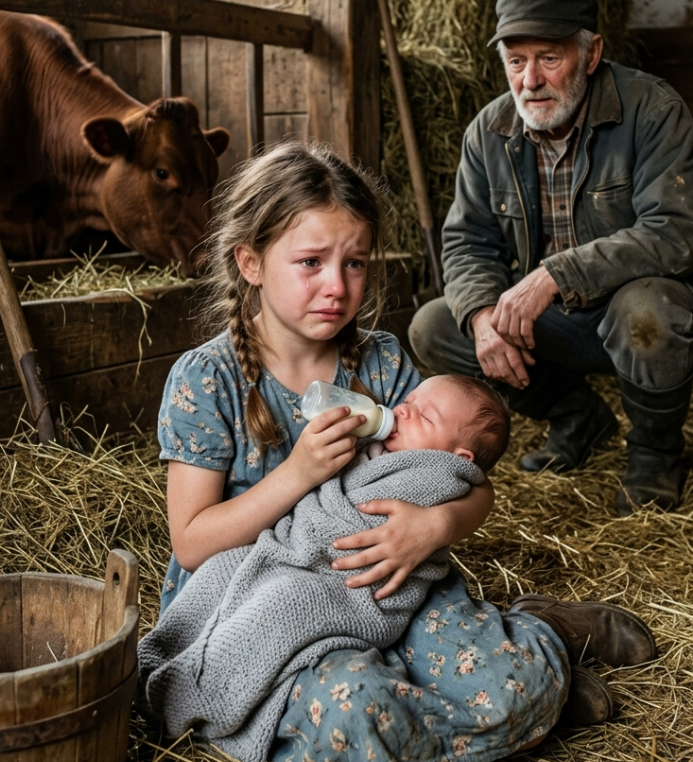
A baby. Maybe six months old. Wrapped in a thin gray blanket. Lying on a pile of straw. His cheeks hollow. His tiny fists barely moving in the air.
Lily rushed to him, dropping to her knees and guiding the bottle to his mouth.
The baby latched on desperately.
I had to brace myself against the doorframe.
“How long have you been here?” I asked quietly.
“Three days,” she said.
Three days.
“Where are your parents?”
She swallowed.
“They said we were going on a trip. Then they left. They said they’d come back.”
The words hit hard.
“Did they leave you here?”
She nodded.

“With food?”
Silence.
“How much did they leave?”
She pointed to a crumpled fast-food bag in the corner. Empty.
My jaw tightened.
“Lily,” I said, kneeling down to her level. “What’s your brother’s name?”
“Ben.”
I looked at the baby. His eyelids fluttered weakly as he drank.
“Why didn’t you go to town?”
She shook her head. “Mama said not to tell anyone where we were. She said if we told, they’d split us up forever.”
There it was.
Not just abandonment.
Fear.
Something planted deep enough to keep her silent.
I had seen things like this before. Years back, a couple in town tried to leave their kids behind to dodge custody fights and payments. But this… this felt colder. Planned.
“Did she say when she’d come back?”
“She said when things got better.”
Things got better.
I rose slowly, my thoughts racing.
“Lily,” I said gently, “I’m going to help you. Both of you. But I need to make a phone call.”
Her face drained of color.
“No!” she cried softly. “Please don’t let them take Ben away!”
I crouched down again.
“No one is taking him from you. I promise.”
It took nearly an hour to calm her enough to get into my truck.
I called Sheriff Dalton first. Then Child Protective Services.
By noon, the truth started to unravel.
Their parents hadn’t “gone on a trip.”
They had left town.
Sold their trailer. Closed their accounts. Disconnected their phones.
They told neighbors they were moving out of state for “work opportunities.”
And they had abandoned two children in an empty shed, assuming no one would find them for days.
Or worse.
The sheriff’s office uncovered something even darker.
The parents had been in a bitter custody dispute with Lily’s grandmother—the mother’s estranged mom—who had filed for guardianship months earlier after repeated reports of neglect.

The state had ordered a home inspection.
Instead of facing it, the parents disappeared.
And hid the children.
Hidden.
Like something to be put away.
By evening, Lily and Ben were resting in the spare bedroom of my farmhouse.
CPS pushed for emergency placement.
I said no.
“They’ll be placed in the system,” the social worker explained gently. “Temporarily.”
“Or they can stay here,” I replied.
“You’re not family.”
“No,” I said quietly. “But I’m the one who found them.”
They hesitated.
Lily hadn’t let go of Ben once.
Not once.
That night, I heard her whisper to him.
“It’s okay, Benny. The cowboy man is nice.”
Cowboy man.
I stepped outside so she wouldn’t see me wipe my eyes.
Within forty-eight hours, the story reached the local news.
They called it an “abandonment scheme.”
The parents believed that if they stayed gone long enough, the court wouldn’t be able to finalize custody with the grandmother.
They assumed the kids would eventually be found and placed in foster care far away from her.
They underestimated a small town.
They underestimated me.
Two days later, the grandmother arrived.
Her name was Margaret.
She looked like someone who hadn’t slept in years.
The moment she saw Lily, she dropped to her knees in my living room.
“Oh, baby,” she cried. “I’ve been looking everywhere.”
Lily froze.
Margaret reached out.
Lily stepped back.
Something inside me cracked.
The court moved quickly after that.
The parents were found two states away and arrested for abandonment and child endangerment.
Margaret filed for immediate custody.
But something no one expected happened.
Lily refused to leave my ranch.
“I don’t want to go,” she whispered during the hearing. “Grandma cries all the time. Mama said she was bad.”

The damage ran deep.
Margaret broke down in tears.
“I tried to save them,” she said. “I called CPS because they were starving. I never wanted to take them away—I wanted them safe.”
The judge made an unusual decision.
Temporary joint placement.
Margaret would move into town.
The children would stay on my ranch.
Supervised visits. Counseling. Time.
Time to rebuild trust.
It wasn’t the courtroom battle people expected.
No shouting lawyers.
No bitterness.
Just grief.
Just guilt.
Just a child trying to figure out who felt safe.
Weeks passed.
Lily started eating full meals.
Ben’s cheeks filled out.
He began to laugh—a bright, bubbling sound that even made the cows turn their heads.
Margaret came every afternoon.
At first, Lily kept her distance.
But one day, I saw them sitting together under the oak tree.
Margaret was brushing Lily’s hair.
Gently.
Carefully.
“I used to do this when you were little,” she whispered.
Lily didn’t pull away.
That’s when I knew things were changing.
Months later, the court granted custody to Margaret.
But with one condition.
The ranch would remain their home.
Margaret moved into the small cottage at the edge of my land.
“Family isn’t always blood,” the judge said. “But sometimes it grows where it’s planted.”
The parents lost all rights.
No final scene.
No apologies.
Just consequences.
Nearly a year later, one morning, Lily walked into my barn as I poured feed.
“Morning, Cowboy Man,” she said with a grin.
It was 5:30 a.m.
I smiled. “Morning, Miss Lily.”
She wasn’t barefoot anymore.
She wasn’t trembling.
She handed me a small jar.
“What’s this?”
“Milk money,” she said proudly. “Grandma gave me chores.”
I chuckled and closed her fingers back around it.
“You don’t owe me anything.”
She tilted her head.
“But you saved us.”
I looked at her—healthy, strong, sunlight catching in her braids.
“No,” I said gently. “You saved each other.”
She paused, thinking about it.
Then she ran back toward the house, where Ben’s laughter drifted through the open windows.
The barn felt warmer somehow.
And every morning at 5:30, when the world is quiet and gray, I remember that small, trembling voice.
“I’m sorry, Mister… I don’t have any money for milk.”
She didn’t have money.
But she had courage.
And sometimes, that matters far more.