I thought I was protecting her. That was the lie I kept telling myself, anyway.
When the factory shut down, the bills piled up so fast they felt like a physical weight on my chest. Eviction was a word the landlord had started using freely. In the midst of all that panic, I looked at our golden retriever, Rusty. He was eating through a forty-pound bag of dog food every two weeks, and he needed a vet visit for his hips that I couldn’t even begin to afford.
I found a wealthy family a few towns over who wanted an older, gentle dog for their property. The money they gave me kept the lights on and a roof over our heads for another month.
But when my seven-year-old daughter, Lily, came home from school that afternoon, dropping her backpack to look for her best friend, I panicked. How could I tell a child that I had traded her dog for electricity? How could I explain that poverty meant you couldn’t afford to love things?
So, I chose the coward’s way out.
“Lily, sweetie,” I said, pulling her onto my lap, my voice shaking. “Rusty got very sick today. He went to sleep, and… he didn’t wake up.”
The sound she made—a sharp, shattered gasp—haunted me for months. She cried until she threw up, and I held her, choking on my own guilt. I told myself it was a clean break. Death is a tragedy a child can eventually understand; betrayal by a parent is not.

The Ghost in the Park
Eight months passed. I found a new job, the financial terror eased, and Lily stopped crying at night. She still drew pictures of Rusty and taped them above her bed, but the sharpest edges of her grief had begun to dull.
Then came the first warm Saturday of spring. I decided to treat Lily to ice cream at a large park across town, far from our usual neighborhood. We were walking along the paved trail, her hand in mine, when she suddenly froze. Her ice cream cone tilted, a drop of melting vanilla landing on her shoe.
“Rusty?” she whispered.
I followed her gaze. About fifty yards away, a woman in a crisp tennis outfit was walking a large, golden dog.
My stomach dropped into my shoes. No. It can’t be.
But the dog had stopped, too. His nose was in the air. He turned his head toward us, and his ears perked up. Even from a distance, I recognized the distinct white patch of fur on his chest and the slight limp in his back left leg.
“Rusty!” Lily screamed.
Before I could grab her arm, she dropped her ice cream and sprinted across the grass.
“Lily, wait!” I yelled, running after her, my heart hammering against my ribs in pure panic.
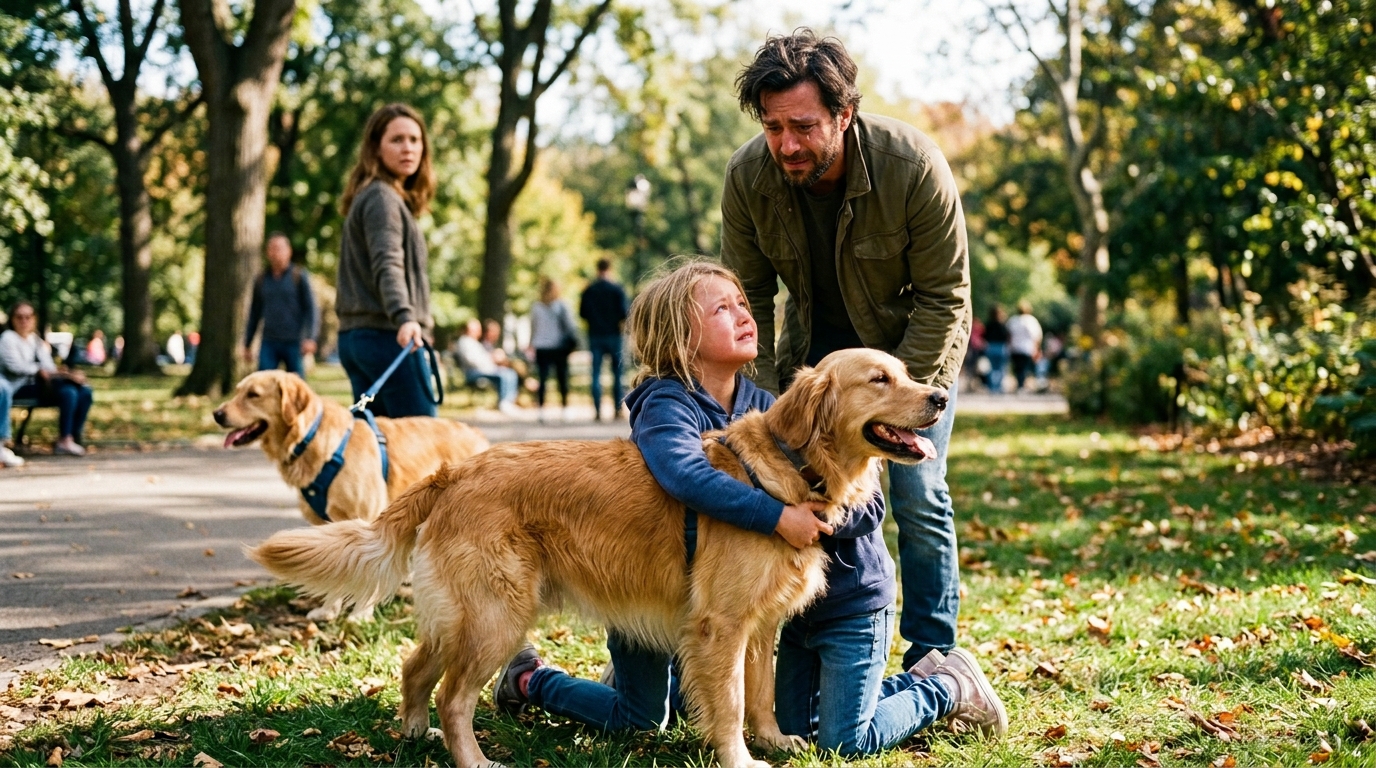
The dog let out a sharp bark and pulled hard against his leash, dragging the woman in the tennis outfit forward. When Lily reached him, she fell to her knees. The dog practically tackled her, his tail wagging so hard his entire body shook. He was whining, licking her face, burying his nose in her neck.
“I knew it!” Lily was sobbing, burying her face in his golden fur. “I knew you weren’t gone! You’re a good boy, Rusty!”
I slowed to a halt, the air entirely knocked out of my lungs.
The woman holding the leash looked bewildered, tugging gently to regain control. “Oh, my! He’s usually so calm. I’m sorry, sweetie, his name is Cooper. We bought him from a family a few months ago.”
The world seemed to stop spinning.
Lily slowly pulled her face away from the dog’s fur. She looked up at the woman, her brow furrowed in confusion. “Bought him?”
Then, she turned to look at me.
The Reckoning
I have never seen a child’s face shift through so many emotions so quickly. First confusion, then dawning comprehension, and finally, a profound, devastating heartbreak that was far worse than the day I told her he had died.
“You…” Lily’s voice was a fragile whisper, barely carrying over the breeze. “You said he died.”
“Lily, I…” I took a step forward, my hands outstretched, but she shrank back against the dog, wrapping her arms protectively around his neck.
“Is this your daughter?” the woman asked, her expression shifting from polite confusion to uncomfortable realization. “Are you the man who…?”
“Yes,” I managed to choke out.
There was no hiding it now. The lie was laid bare, ugly and undeniable in the bright spring sunlight. I had stolen her grief under false pretenses. I had made her mourn a ghost while the dog she loved was living a few miles away.
“I’m so sorry,” I said, tears finally spilling over my eyelids. I knelt on the grass a few feet from her. “Lily, I’m so sorry. We had no money. We were going to lose the house. I wanted him to have a good home, and I didn’t want you to think it was your fault.”
Lily didn’t say a word. She just kept her arms wrapped around Rusty—Cooper—her small shoulders trembling. She gave him one last, long kiss on the top of his head, stood up, and wiped her eyes with the back of her sleeve.
She walked past me without looking at my face, heading straight for the car.
I thanked the woman, my voice entirely hollow, and turned to follow my daughter. The drive home was suffocatingly silent. I had regained my financial footing, and the bills were paid, but as I looked at Lily staring blankly out the passenger window, I realized the true cost of what I had done.
I had sold the dog to save the house, but in the process, I had broken the home.