My mom died when I was ten. Dad remarried when I was fourteen. Cheryl was the kind of woman who smiled for show and snapped in secret. At church, she touched my shoulder and called me “our sweet boy.”
At home, she called me “your father’s baggage.” When Dad suddenly died five years later, Cheryl did not even wait for the funeral flowers to wilt. Two days after the funeral, she crossed her arms in the hallway and said, “You’re not family anymore. Get out.”
So I left with one duffel bag and my guitar.
I was nineteen years old, grieving, stunned, and too exhausted to fight a woman who had been waiting years to erase me.
That night, I slept on my friend Mason’s floor with my jacket folded under my head.
I stared at the ceiling until sunrise, listening to his old fan rattle in the corner.
All I could think about was Dad.
His laugh.
His truck.
The way he tapped the steering wheel when he listened to classic rock.
The way he always said, “Ethan, no matter what happens, this house is your home.”
And then Cheryl’s voice cut through the memory.
You’re not family anymore.
Get out.
The next morning, I went back to grab the rest of my things.
I expected locked doors.
Maybe Cheryl standing on the porch with boxes.
Maybe a police officer because she had decided to call me a trespasser.
But when Mason pulled his car to the curb, I froze.
Five black SUVs were parked outside my father’s house.
Not one.
Five.
Dark windows.
Polished tires.
Men in suits standing near the porch.
For a second, I thought Cheryl had hired private security to keep me away.
My stomach tightened.
Mason looked at me.
“Dude, do you want me to come in?”
I swallowed.
“No. Wait here.”
I got out with my guitar case still in my hand and walked up the path.
The front door opened before I could knock.
Cheryl stood there.
Pale.
Not irritated.
Not smug.
Pale.
“Oh,” she said, forcing a smile so fast it almost cracked her face. “I was just about to call you, sweetheart.”
Sweetheart.
Yesterday I had not been family.
Today I was sweetheart.
I blinked.
“What’s going on?”
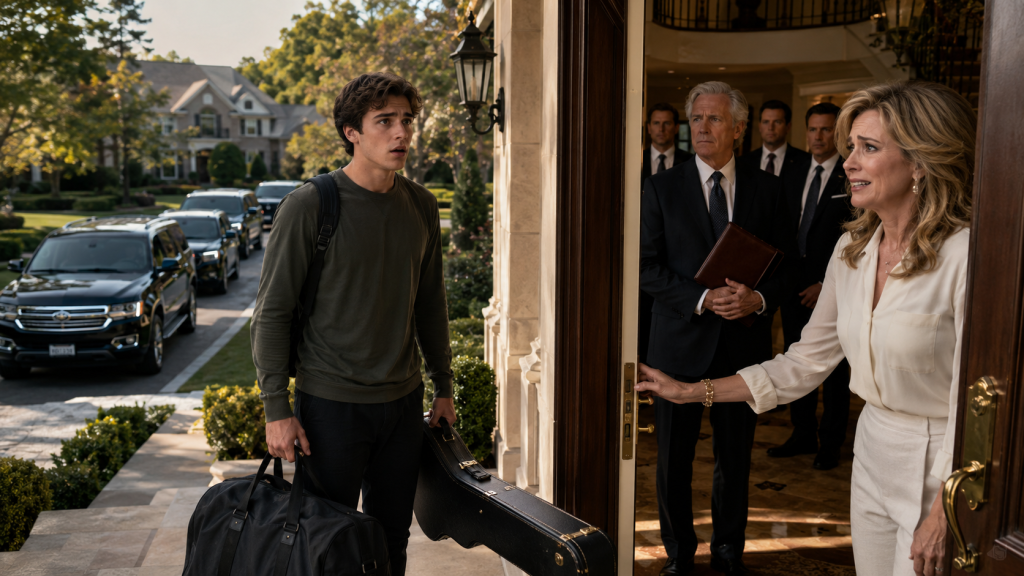
She stepped forward like she might block the doorway, but one of the men behind her cleared his throat.
That was when I saw the foyer.
Men in dark suits filled it like a storm had stepped inside.
One stood beside the staircase.
Another near Dad’s office.
A third held a leather folder with my father’s name stamped across the front.
Daniel Whitmore.
My father.
The house suddenly felt unfamiliar.
Cheryl’s smile trembled.
“Come in, Ethan. We were just discussing some adult matters.”
“Adult matters?” I repeated.
“You can get your things later,” she said quickly. “This really isn’t a good time.”
An older man with silver hair stepped forward.
“You must be Ethan.”
I nodded slowly.
“Yes.”
“My name is William Harlow. I was your father’s attorney.”
My fingers tightened around the handle of my guitar case.
“Attorney?”
Cheryl cut in sharply.
“This is private. Ethan can come back later.”
Mr. Harlow turned to her.
“No, Mrs. Whitmore. He is exactly who we came to see.”
The room went silent.
Cheryl’s pale face turned even whiter.
Mr. Harlow opened the leather folder and pulled out a sealed envelope.
“Your father updated his will three months before he died. He left specific instructions in case anyone tried to remove you from this home.”
My heart pounded.
“What instructions?”
Cheryl whispered, “Please don’t do this here.”
Mr. Harlow ignored her and handed me the envelope.
On the front, in Dad’s handwriting, were six words that made my knees nearly give out.
To my son, the real owner.
For a moment, I could not breathe.
The real owner.
I looked at Cheryl.
Her lips had gone thin.
“What does this mean?” I asked.
Mr. Harlow spoke carefully.
“It means your father anticipated a problem. After your mother passed, this home was transferred into a protected trust. You are the sole beneficiary.”
Cheryl snapped, “That is not what Daniel told me.”
Mr. Harlow did not even look surprised.
“Perhaps not. But it is what Daniel signed.”
One of the suited men handed him another folder.
Mr. Harlow continued.
“Your father granted Mrs. Whitmore a temporary right of occupancy only as long as she did not interfere with your access, remove you from the property, sell assets belonging to the trust, or attempt to conceal the documents.”
Cheryl’s eyes darted toward Dad’s office.
I noticed.
So did everyone else.
Mr. Harlow followed her gaze.
“That is why we arrived with witnesses this morning.”
My mouth went dry.
“Witnesses for what?”
“To secure the estate.”
I looked around.
The men were not security guards.
They were accountants.
Trust officers.
A private investigator.
A locksmith.
The realization made the room tilt.
My father had known.
Maybe not everything.
But enough.
Cheryl laughed once, sharp and fake.
“This is ridiculous. Ethan is a child. He cannot own a house.”
“I’m nineteen,” I said quietly.
She turned on me.
“You are a teenager with a guitar and no job.”
Mr. Harlow’s voice cut through the room.
“He is an adult, and your opinion has no legal value here.”
Cheryl’s mouth snapped shut.
No one had ever spoken to her that way.
Not in her own performance space.
Not in the house she had spent years pretending was hers.
Mr. Harlow handed me another envelope.
“Your father also left a letter. You may read it privately, or now.”
My hands shook as I opened it.
Dad’s handwriting blurred through my tears.
Ethan,
If you are reading this, I am gone, and I am sorry I did not get more time with you.
I know things have been hard since your mother died.
I also know I failed you in ways I may never have had the courage to admit out loud.
I married Cheryl because I was lonely.
That loneliness cost you peace.
For that, I am sorry.
This house was your mother’s dream before it was mine.
Every flower in the garden, every blue tile in the kitchen, every mark on the garage door where we measured your height belongs to your history.
No one has the right to erase you from it.
I have protected the house for you.
If anyone tells you that you do not belong, remember this:
You belonged here before they ever crossed the threshold.
Be brave.
Trust Mr. Harlow.
And please, son, keep playing guitar.
Your mother loved hearing you play.
Love,
Dad
I did not realize I was crying until a tear hit the paper.
The foyer was quiet.
Even Cheryl did not speak.
For once, grief filled the room honestly.
Not as flowers.
Not as polite condolences.
As a son holding the last words of a father who had finally seen him.
I folded the letter carefully.
Mr. Harlow softened his voice.
“Ethan, your father asked us to come this morning because Mrs. Whitmore contacted a broker yesterday evening.”
Cheryl stiffened.
“A broker?” I asked.
“She attempted to schedule a valuation of the property.”
I looked at her.
“You tried to sell the house?”
Her face hardened.
“I was grieving. People make calls.”
Mr. Harlow opened another document.
“She also contacted the bank regarding accounts that had been locked by the trust. She asked whether a surviving spouse could access funds without notifying a beneficiary.”
My stomach turned.
Dad had been buried two days ago.
Two days.
And Cheryl had already tried to sell the house and find the money.
I remembered her crying at the funeral.
Her perfect black dress.
Her handkerchief.
The way people told me, “Take care of Cheryl. She lost her husband.”
No.
Cheryl had lost access.
That was what frightened her.
Mr. Harlow continued.
“Because she removed you from the property last night, her occupancy right may now be terminated.”
Cheryl exploded.
“You cannot throw me out of my own home.”
Mr. Harlow looked at her.
“It is not your home.”
The words landed like thunder.
For years, Cheryl had acted like every wall obeyed her.
She redecorated Mom’s kitchen.
Threw away old family photos.
Took down the painting my mother made of the lake.
Moved my room to the basement because she said my old room had better light for her sewing space.
And now one calm sentence stripped it all away.
It is not your home.
Cheryl pointed at me.
“You would let them do this to me?”
I stared at her.
“You kicked me out two days after my father’s funeral.”
“I was upset.”
“You told me I wasn’t family.”
She swallowed.
“That was grief talking.”
“No,” I said. “That was you talking when you thought nobody could stop you.”
Her face twisted.
“You ungrateful little—”
“Mrs. Whitmore,” Mr. Harlow interrupted, “I strongly suggest you stop speaking.”
She looked around the room and realized no one was on her side.
Not one person.
That was when she tried to change.
Her shoulders sagged.
Her eyes filled.
“Ethan,” she whispered, “your father would be ashamed if you made me homeless.”
I almost believed the tears.
Almost.
Then I remembered being fourteen, standing in the kitchen while she told me my mother was gone and I needed to stop acting like the house was a shrine.
I remembered being sixteen and finding my mother’s Christmas ornaments in the trash.
I remembered Dad saying, “Cheryl is trying,” because grief had made him blind and guilt had made him weak.
I remembered all the nights I sat in the garage playing guitar because it was the only place I could breathe.
“My father protected me from exactly this,” I said.
Her tears stopped too quickly.
Mr. Harlow nodded to the locksmith.
“We are changing locks today. Mrs. Whitmore will be given supervised access to collect her personal belongings. Any items belonging to Mr. Whitmore, his first wife, or the trust will remain here pending inventory.”
Cheryl shouted, “You cannot inventory my things.”
One of the accountants opened a folder.
“We have photographs from Mr. Whitmore’s records. We also have receipts, insurance schedules, and trust inventory lists.”
Cheryl’s expression shifted again.
Fear.
Real fear.
Mr. Harlow noticed.
“What did you remove from the house last night?”
“Nothing.”
The answer came too fast.
Mr. Harlow looked toward the private investigator.
The man in the gray suit stepped forward.
“Mrs. Whitmore, yesterday at 6:42 p.m., you carried two storage bins into your sister’s SUV. At 7:15, you placed a locked blue case into the same vehicle.”
My breath caught.
The blue case.
Dad’s office safe case.
He kept old family documents in it.
My birth certificate.
Mom’s letters.
Insurance papers.
A photo album from before I was born.
Cheryl looked trapped.
“That case belonged to my husband.”
“It belonged to the trust,” Mr. Harlow said.
Then he turned to me.
“Ethan, do you know what was in the blue case?”
I nodded slowly.
“Family papers. My mom’s letters. Dad’s old military watch. Some photos.”
Cheryl snapped, “They were sentimental items. I was preserving them.”
“By taking them to your sister’s house after evicting the beneficiary?” Mr. Harlow asked.
She said nothing.
He looked at the investigator.
“Recover it.”
The investigator made a call.
Cheryl sat down hard on the bench near the staircase.
For the first time since I met her, she looked small.
Not harmless.
Just cornered.
The next hour passed like a strange dream.
The locksmith changed every exterior lock.
The accountants photographed rooms.
The trust officers walked through Dad’s office.
Mason texted me three times from outside asking if I was okay.
I answered:
I think the house is mine.
He replied:
WHAT.
I almost laughed.
Almost.
Then I went upstairs.
My old room had become Cheryl’s sewing room, just as she wanted.
Bolts of fabric covered the desk Dad built for me.
A mannequin stood where my bed once had.
The walls were painted pale green over the blue Mom had chosen.
I stood there holding my guitar case and felt grief rise like water.
Mr. Harlow appeared quietly in the doorway.
“Your father wanted that room restored if you wished.”
I swallowed.
“He wrote that?”
“Yes.”
“He really thought of everything.”
Mr. Harlow’s face softened.
“He thought of you.”
That broke me more than everything else.
For years, I had believed Dad did not see what Cheryl did.
Maybe he saw too late.
Maybe he was ashamed.
Maybe illness scared him into finally fixing what he had failed to protect while alive.
It did not erase the hurt.
But it gave me something solid to stand on.
By noon, the blue case was recovered from Cheryl’s sister.
The investigator carried it into the kitchen and set it on the table.
Cheryl refused to look at it.
Mr. Harlow opened it with the key from Dad’s desk.
Inside were the documents I remembered.
Birth certificate.
Mom’s letters.
Dad’s watch.
Photo albums.
And one more envelope.
My name again.
This time, the handwriting was my mother’s.
I forgot how to breathe.
“My mom wrote this?”
Mr. Harlow nodded.
“Your father found it while organizing the trust paperwork. He asked that it be given to you only if conflict arose over the house.”
My hands trembled as I opened it.
My mother’s handwriting was softer than Dad’s.
Ethan, my beautiful boy,
If you are old enough to read this, then life has already asked too much of you.
I hope your father has filled this house with music and laughter.
I hope someone has kept the garden alive.
I hope the kitchen still smells like cinnamon in December.
But if anyone ever makes you feel like a guest in the home we built for you, listen to me now.
You are not a guest.
You are the reason we built it.
A house is not just walls.
It is memory.
It is belonging.
It is the place where love leaves fingerprints.
Mine are everywhere, even if someone paints over them.
Find them.
Keep them.
And never let anyone convince you that losing me meant losing your place in this world.
Love,
Mom
I sat at the kitchen table and cried with both letters in my hands.
Dad’s.
Mom’s.
Two voices from the past reaching through the worst morning of my life to tell me I belonged.
Cheryl watched me cry and, for once, had no weapon for it.
Maybe because even she knew grief like that could not be manipulated.
By evening, she had packed three suitcases under supervision.
She argued over jewelry.
Over furniture.
Over a silver serving tray that had belonged to my grandmother.
She lost each argument when the inventory proved otherwise.
Finally, she stood at the front door, wearing sunglasses though the sun had already begun to set.
“You’ll regret this,” she said.
I looked at her.
“No. I regret not knowing sooner.”
Her mouth tightened.
“You think a house will replace your father?”
“No,” I said. “But losing it would have let you erase him.”
She had no answer.
When the door closed behind her, the house went quiet.
Not empty.
Quiet.
There is a difference.
Mason came in after the SUVs left.
He looked around the foyer.
“So,” he said carefully, “do I take my shoes off in your mansion now?”
I laughed.
For the first time in days, I laughed so hard I had to sit on the stairs.
Then I cried again.
Mason sat beside me and put a hand on my shoulder.
“She was awful,” he said.
“Yeah.”
“Your dad came through, though.”
I looked toward his office.
“Late.”
Mason nodded.
“Still counts.”
Maybe it did.
Maybe it did not.
Grief is not math.
It does not balance neatly.
Dad had failed me while he was alive in ways a trust could not fully repair.
But he had also protected me when it mattered most.
Both things were true.
That night, I slept in my old room on a mattress Mason helped drag upstairs from the basement.
The green walls still smelled like Cheryl’s perfume.
Fabric scraps still hid under the desk.
But the window was open, and cool air moved through the room.
I placed my guitar beside the bed.
Before sleeping, I read both letters again.
The next morning, I started restoring the house.
Not all at once.
A home should not be reclaimed in anger.
It should be reclaimed with care.
I found Mom’s painting of the lake wrapped in plastic in the garage.
I hung it back in the hallway.
I took down Cheryl’s stiff curtains.
I found the old Christmas ornaments in a storage bin Cheryl must have missed and carried them like treasure to the attic.
I moved the sewing mannequin out of my room.
I sanded the desk Dad built for me.
Under the paint near the edge, I found initials carved into the wood.
E.W.
I had done that when I was twelve.
Dad had pretended to be angry, then carved a tiny D.W. beside mine when Mom wasn’t looking.
I ran my fingers over both sets of letters.
A week later, Mr. Harlow returned with the final paperwork.
“The trust is now fully under your control,” he said. “Your father also left funds for property taxes, maintenance, education, and living expenses.”
I shook my head.
“He left money too?”
“Yes. But the house was his main concern.”
I looked around the kitchen.
The blue tile.
The window above the sink.
The breakfast nook where Mom used to drink tea.
“I almost left it.”
“You did leave,” Mr. Harlow said gently. “Then you came back.”
That stayed with me.
Sometimes survival looks like leaving.
Sometimes courage looks like coming back for your things.
Months passed.
Cheryl tried to contest the trust.
She failed.
She claimed emotional distress.
She claimed Dad had been manipulated.
She claimed I had turned him against her.
But documents do not care how loudly people lie.
The signatures held.
The medical records proved Dad was competent.
The attorney notes showed he understood exactly what he was doing.
Cheryl lost not because she was unlucky.
She lost because Dad had planned for the truth to outlive him.
I did not become rich overnight in the way people imagine.
I still worked.
Still played music at small bars on weekends.
Still ate ramen when I forgot to grocery shop.
But I had a home.
A real one.
One nobody could throw me out of with folded arms and a cruel smile.
On the first anniversary of Dad’s death, I invited a few people over.
Mason.
My aunt Rebecca.
Two friends from college.
Mr. Harlow came too, though he said he could only stay for coffee.
We sat in the backyard under the lights Dad had strung years ago.
I played guitar.
Not well enough to impress strangers.
Well enough to make my mother’s memory feel near.
After everyone left, I stood alone in the kitchen.
For years, that room had held Cheryl’s voice.
Her rules.
Her criticism.
But now it smelled like cinnamon because I had baked my mother’s old apple cake.
The recipe had been in the blue case.
Folded between letters.
I looked around and finally understood something.
Cheryl had been wrong.
Family was not whatever she declared from the hallway.
Family was handwriting on envelopes.
A carved desk.
A protected deed.
A recipe saved for a son.
A father trying, too late but not too little, to make sure his child was not erased.
And me.
Still standing.
Still belonging.
When Cheryl told me I was not family anymore, she thought she was closing the door.
But all she did was trigger the plan my father had left behind.
The black SUVs.
The attorney.
The trust.
The letters.
The proof.
She thought I would come back begging for my belongings.
Instead, I came back to find out the house had been waiting for me all along.
My father’s house.
My mother’s dream.
My home.
THE END! Many thanks for your reading!