Part 1
I asked my sister if I could stay at her place for three nights because I was having surgery for a brain tumor, and she replied: “Not a chance, you’re coming out of the hospital full of bacteria; pay for a hotel like any other adult.” She lived in the condo whose mortgage I had been paying for three years… so I hung up, canceled her $1,500 monthly payment, blocked her secondary credit card, and waited for her perfectly clean apartment to try and pay the bank.
My name is Gabrielle Torres, I am thirty-one years old, and for a long time, I believed that helping family didn’t require receipts.
My older sister, Mariela, was always the “star” of the family. The one who spoke the loudest, the one who knew how to ask for things, the one who cried beautifully whenever it suited her. When she got a condo in downtown Chicago, she said it was “the opportunity of a lifetime.” My parents gave her the down payment with their retirement savings, and I agreed to pay part of the mortgage while she “got on her feet.”
“Just three years, Gaby,” she told me. “I swear I’ll pay you back with interest.”
She never paid me back. And I never asked her to.
On the first of every month, I transferred fifteen hundred dollars. Additionally, she had a secondary credit card linked to my account because, according to her, she needed to cover “apartment emergencies.” Her “emergencies” were manicures in the Gold Coast, dinners with friends, expensive shoes, and minimalist decor to show off on Instagram.
I worked as a financial coordinator in Austin. I made good money, yes, but I wasn’t rolling in it. I got up early, worked overtime, turned down vacations, put off fixing my car, and ate cheaply during the week so that Mariela wouldn’t fall behind with the bank.
A month ago, they found a tumor. Benign, the doctor said, but poorly located. The surgery had to be performed in Chicago, near the neurology institute. When I thought about where to stay, the logical choice came to mind: my sister’s place. That spacious, clean, bright home—paid for, in part, by my own back.
I called her one night. “Sis, I’m flying to Chicago next week for surgery. Can I stay with you for a few days?” There was a silence. Then she let out a dry laugh. “At my place? Gaby, don’t be ridiculous. I’m obsessive about cleanliness. You’re going to be coming out of the hospital with who knows what kind of bacteria. Better book a hotel.”
I stood still. “It would only be three nights.” “I can’t risk my space. Besides, my building is very strict with visitors. You understand, right?”
Yes. I understood perfectly. I understood that my fifteen hundred dollars a month didn’t carry bacteria. My secondary credit card didn’t, either. My sacrifices didn’t, either. I was the one who was sick, not my money.
“That’s fine,” I said. I hung up. I didn’t cry. I opened my banking app. I went to scheduled transfers. Beneficiary: Mariela Torres. Amount: $1,500. Reference: Mortgage. I pressed cancel. Then I went to secondary cards. Mariela Torres. Limit: $2,500. I pressed block. The screen asked for confirmation. I accepted. It was clean. Cleaner than her house.
That night, I booked a suite near the hospital. I paid for a private nurse, private transport, and pre-surgical tests. For the first time in years, I used my money for myself without feeling guilty.
When I arrived in Chicago, I didn’t let her know. A college friend, Valeria, accompanied me to the hospital. While she was filling out forms, my cell phone started vibrating nonstop. Mariela. Then my mom. Then Mariela again. Finally, a message arrived: “Why was my card declined? I’m at a dinner. How embarrassing.” Then: “Gaby, the bank called me. Why didn’t the transfer go through?” And then one that left me cold: “You can’t do this to me. The house is your responsibility too, because you signed as a joint guarantor.”
Joint guarantor. She had never said that to me before. I asked Valeria to read the message. Her face changed. “Gabrielle… what did you sign?” “Nothing.” Valeria took a deep breath. “Then before you go into surgery, we are going to look into that mortgage.”
That afternoon, her contact at a notary office obtained a copy of the file. There was my name. My driver’s license number. My signature. But it wasn’t my signature. It was a clumsy imitation, pasted onto a contract where I appeared as the joint guarantor for Mariela’s entire loan. And on the last page, there was a clause that left me breathless: “In case of default, direct contact with the guarantor Gabrielle Torres is authorized for full liquidation of the debt.”
Just then, a message from Mariela popped up: “If you don’t pay this month, you’re going to find out exactly what you signed for playing the ‘good sister.’”
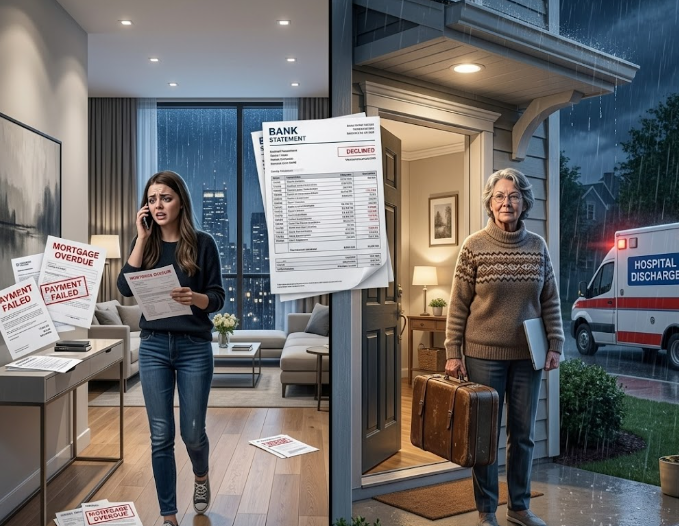
Part 2
I read Mariela’s message three times, sitting on the suite bed with my hospital gown folded on a chair and my pre-surgical reports on the table. “You’re going to find out what you signed.” That didn’t sound like a desperate sister. It sounded like someone who had been waiting for a long time to spring a trap. Valeria took my phone and screenshotted everything. “Don’t answer her,” she told me. “First, we’re going to protect you.” I wanted to think about my surgery, the tumor, the anesthesia—anything but the fake signature that had just appeared in a mortgage file. But life doesn’t ask when it’s convenient for you to fall apart. Valeria called a mortgage attorney and a handwriting expert. I called the bank, requested a certified copy of everything, and left a formal alert: I disavowed that signature and any joint liability. The executive tried to speak to me with a scripted tone. “Ms. Torres, your consent is shown here.” “A fraud is shown here,” I replied. “And if you try to collect from me before investigating, your bank will also be included in the lawsuit.”