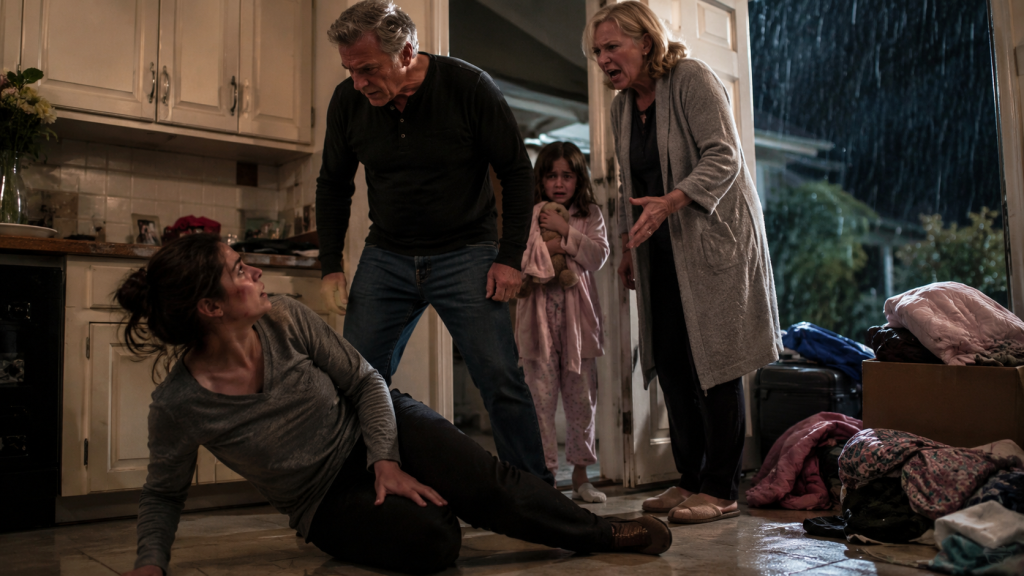
When I brought my daughter home from the ER, my mother had already thrown all our belongings outside. “Pay her rent or get out!” she screamed, demanding $2,000. I refused. My father slapped me so hard I hit the ground, bleeding right in front of my child.
He sneered, “Maybe now you’ll obey.” They thought that would break me. They had no idea what I was about to do next. The blood hit the kitchen tile before I understood my father had actually struck me. For one second, there was no pain.
Only sound. My daughter screaming. The rain hitting the windows. My mother shouting over both of us. Then the burning came. My cheek. My lip. The side of my head where I had hit the cabinet on the way down.
My daughter, Ava, still wearing her hospital wristband, screamed like the whole house had caught fire.
“Mom!”
I pushed myself up on one elbow.
The room swam.
Across from me, my father stood with his hand still half-raised, breathing hard, as if I had forced him to do it by refusing to be useful.
My mother stood beside him in her house slippers, pointing toward the front lawn.
Through the open door, I could see everything we owned scattered in the rain.
Trash bags.
Laundry baskets.
Ava’s pink blanket.
Her stuffed rabbit.
My work shoes.
Our medication bag.
The discharge papers from the ER.
Everything.
Thrown into the mud like we were garbage.
“Two thousand dollars,” my mother snapped. “Or you and that sick little girl can sleep outside.”
Ava made a small sound behind me.
Not a scream this time.
Something worse.
A frightened little gasp that sounded like a piece of childhood breaking.
She was seven years old.
Seven.
She had spent the last six hours in the emergency room with a fever that would not come down and breathing that scared me so badly I drove through red lights with my hazard lights on.
The doctor said it was a severe respiratory infection.
He gave instructions.
Medication.
A warning list.
A follow-up appointment.
And now, less than an hour after leaving the hospital, my daughter was standing in my parents’ kitchen watching her grandfather hit her mother.
That was when something inside me went silent.
I looked at Ava, shaking near the doorway, her hospital bracelet still taped around her tiny wrist.
I knew this was the last time they would ever see me beg.
I reached for my phone with bloody fingers.
My father laughed.
“Go ahead,” he said. “Tell them you fell.”
But the call had already connected.
“911, what is your emergency?”
Before I could speak, Ava cried out, “Grandpa hit Mommy!”
My mother went pale.
My father froze.
Then I turned the phone toward the yard, showing every bag they had thrown out, every soaked prescription, every piece of proof.
“I need police and medical help,” I said clearly. “My father assaulted me, my child just left the ER, and my parents are trying to force us out illegally.”
My father stepped toward me.
“Hang up that phone.”
I backed away, keeping myself between him and Ava.
“Do not come closer.”
The dispatcher’s voice stayed calm in my ear.
“Ma’am, stay on the line. Officers and medical assistance are on the way. Are you in immediate danger?”
I looked at my father.
At the man who had taught me to ride a bike.
At the man who once carried me from the car after I fell asleep on road trips.
At the man who now looked more angry about being exposed than sorry for what he had done.
“Yes,” I said. “I believe we are.”
My mother snapped, “Don’t be dramatic. Nobody is in danger. She always does this.”
Always.
That word had followed me my whole life.
I always overreacted.
I always misunderstood.
I always made things hard.
I always owed them.
When I was twelve and my mother spent my birthday money on groceries, I was selfish for crying.
When I was seventeen and my father took my savings to cover his truck payment, I was ungrateful for asking when he would repay it.
When I became pregnant at twenty-three and Ava’s father disappeared before she was born, they told me I had embarrassed the family.
Then they offered me a room in their house.
Not freely.
Never freely.
“Just until you get on your feet,” my mother said.
But getting on my feet was hard when they kept moving the ground.
At first, it was small things.
Buy groceries.
Pay the electric bill.
Cover Dad’s insurance.
Help Mom with her credit card.
Then came rent.
Eight hundred.
Then twelve hundred.
Then fifteen hundred.
Now two thousand dollars for one bedroom and a corner of the basement where Ava and I kept our things.
I worked full-time at a medical billing office.
I took weekend shifts at a pharmacy.
I paid for food, school supplies, utilities, and half their mortgage while they called it “helping me.”
Every time I tried to save enough to leave, there was another emergency.
Mom’s dental bill.
Dad’s truck tires.
A broken water heater.
A property tax deadline.
And always, always, the same sentence.
“Family helps family.”
But family, I was learning, was just the word they used when they wanted money without guilt.
Ten minutes after my 911 call, flashing lights filled the driveway.
The red and blue glare washed over the wet lawn, over Ava’s blanket in the mud, over the medication bag lying open beside my work uniforms.
My father’s confidence vanished when the first officer entered.
He transformed instantly.
His shoulders lowered.
His voice softened.
His face became the face he used at church picnics.
“Officer, thank God you’re here. My daughter is having some kind of episode.”
I almost laughed.
The paramedic came in behind the officers and looked at me first.
Then Ava.
Then the blood on the tile.
Then the hospital bracelet on Ava’s wrist.
“Ma’am, sit down,” she said gently.
“I’m okay.”
“No,” she said. “You’re not.”
That kindness nearly broke me.
Ava ran to my side when the paramedic guided me into a chair.
Her small hands clutched my sleeve.
“Don’t let them take you,” she whispered.
I wrapped one arm around her.
“Nobody is taking me from you.”
One officer knelt in front of Ava.
He kept his voice soft.
“Hi, sweetheart. My name is Officer Miller. Are you feeling sick tonight?”
Ava nodded.
“Did you just come from the hospital?”
Another nod.
“Can you tell me what happened when you came home?”
My mother interrupted.
“She is a child. She doesn’t understand adult matters.”
Officer Miller did not look away from Ava.
“I asked her.”
Ava swallowed.
“Grandma put our stuff outside. Mom said we had to get my medicine. Grandpa got mad. Then he hit Mom.”
My father snapped, “She’s exaggerating.”
The other officer looked at the wet lawn through the open door.
“Sir, is that the child’s medication outside?”
My father did not answer.
My mother crossed her arms.
“She owes us rent.”
Officer Miller stood.
“So you threw a sick child’s prescriptions into the rain?”
“It was in a bag,” my mother said, as if that made it reasonable.
The paramedic cleaned my lip while another checked Ava’s temperature.
Still elevated.
Not dangerous yet, but too high for the stress she had just endured.
The paramedic found the medication bag outside.
Some labels were wet but readable.
One bottle was cracked.
The discharge papers were soaked.
She brought everything in carefully, as if each item was evidence.
Because it was.
The officers separated us.
One spoke to me in the living room.
One spoke to my parents in the kitchen.
I could hear my mother’s voice rising.
“She is thirty-two years old. She cannot expect to live here for free.”
Then my father.
“She got in my face.”
Then my mother again.
“She manipulates that child.”
I sat on the sofa with Ava under my arm and realized something.
For years, I had argued with them in the wrong room.
I tried to explain pain to people committed to causing it.
I tried to make them understand what they already understood perfectly.
They knew I was trapped.
That was why they kept tightening the walls.
The officer asked if I lived there.






