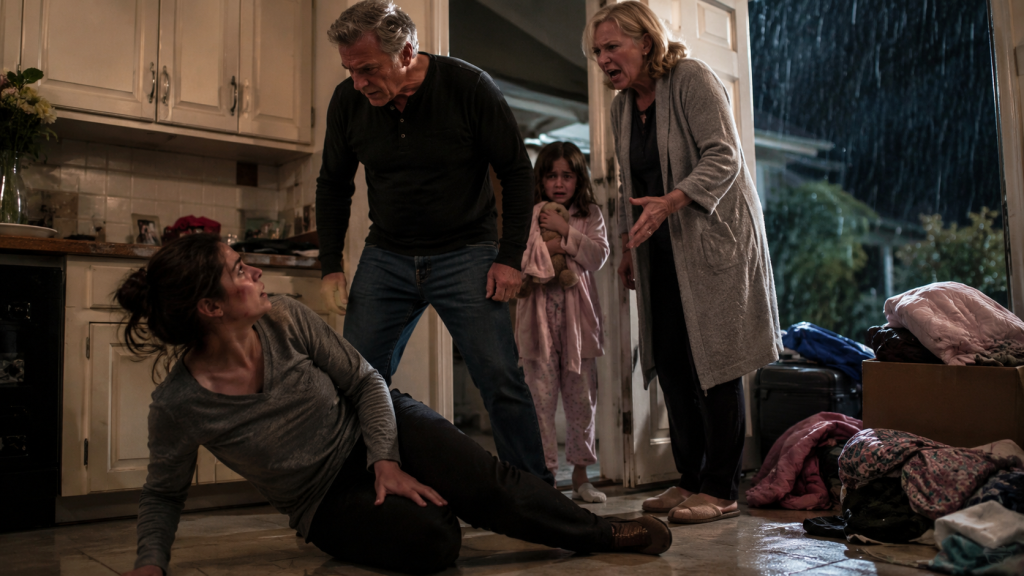
When I brought my daughter home from the ER, my mother had already thrown all our belongings outside. “Pay her rent or get out!” she screamed, demanding $2,000. I refused. My father slapped me so hard I hit the ground, bleeding right in front of my child.
He sneered, “Maybe now you’ll obey.” They thought that would break me. They had no idea what I was about to do next. The blood hit the kitchen tile before I understood my father had actually struck me. For one second, there was no pain.
Only sound. My daughter screaming. The rain hitting the windows. My mother shouting over both of us. Then the burning came. My cheek. My lip. The side of my head where I had hit the cabinet on the way down.
My daughter, Ava, still wearing her hospital wristband, screamed like the whole house had caught fire.
“Mom!”
I pushed myself up on one elbow.
The room swam.
Across from me, my father stood with his hand still half-raised, breathing hard, as if I had forced him to do it by refusing to be useful.
My mother stood beside him in her house slippers, pointing toward the front lawn.
Through the open door, I could see everything we owned scattered in the rain.
Trash bags.
Laundry baskets.
Ava’s pink blanket.
Her stuffed rabbit.
My work shoes.
Our medication bag.
The discharge papers from the ER.
Everything.
Thrown into the mud like we were garbage.
“Two thousand dollars,” my mother snapped. “Or you and that sick little girl can sleep outside.”
Ava made a small sound behind me.
Not a scream this time.
Something worse.
A frightened little gasp that sounded like a piece of childhood breaking.
She was seven years old.
Seven.
She had spent the last six hours in the emergency room with a fever that would not come down and breathing that scared me so badly I drove through red lights with my hazard lights on.
The doctor said it was a severe respiratory infection.
He gave instructions.
Medication.
A warning list.
A follow-up appointment.
And now, less than an hour after leaving the hospital, my daughter was standing in my parents’ kitchen watching her grandfather hit her mother.
That was when something inside me went silent.
I looked at Ava, shaking near the doorway, her hospital bracelet still taped around her tiny wrist.
I knew this was the last time they would ever see me beg.
I reached for my phone with bloody fingers.
My father laughed.
“Go ahead,” he said. “Tell them you fell.”
But the call had already connected.
“911, what is your emergency?”
Before I could speak, Ava cried out, “Grandpa hit Mommy!”
My mother went pale.
My father froze.
Then I turned the phone toward the yard, showing every bag they had thrown out, every soaked prescription, every piece of proof.
“I need police and medical help,” I said clearly. “My father assaulted me, my child just left the ER, and my parents are trying to force us out illegally.”
My father stepped toward me.
“Hang up that phone.”
I backed away, keeping myself between him and Ava.
“Do not come closer.”
The dispatcher’s voice stayed calm in my ear.
“Ma’am, stay on the line. Officers and medical assistance are on the way. Are you in immediate danger?”
I looked at my father.
At the man who had taught me to ride a bike.
At the man who once carried me from the car after I fell asleep on road trips.
At the man who now looked more angry about being exposed than sorry for what he had done.
“Yes,” I said. “I believe we are.”
My mother snapped, “Don’t be dramatic. Nobody is in danger. She always does this.”
Always.
That word had followed me my whole life.
I always overreacted.
I always misunderstood.
I always made things hard.
I always owed them.
When I was twelve and my mother spent my birthday money on groceries, I was selfish for crying.
When I was seventeen and my father took my savings to cover his truck payment, I was ungrateful for asking when he would repay it.
When I became pregnant at twenty-three and Ava’s father disappeared before she was born, they told me I had embarrassed the family.
Then they offered me a room in their house.
Not freely.
Never freely.
“Just until you get on your feet,” my mother said.
But getting on my feet was hard when they kept moving the ground.
At first, it was small things.
Buy groceries.
Pay the electric bill.
Cover Dad’s insurance.
Help Mom with her credit card.
Then came rent.
Eight hundred.
Then twelve hundred.
Then fifteen hundred.
Now two thousand dollars for one bedroom and a corner of the basement where Ava and I kept our things.
I worked full-time at a medical billing office.
I took weekend shifts at a pharmacy.
I paid for food, school supplies, utilities, and half their mortgage while they called it “helping me.”
Every time I tried to save enough to leave, there was another emergency.
Mom’s dental bill.
Dad’s truck tires.
A broken water heater.
A property tax deadline.
And always, always, the same sentence.
“Family helps family.”
But family, I was learning, was just the word they used when they wanted money without guilt.
Ten minutes after my 911 call, flashing lights filled the driveway.
The red and blue glare washed over the wet lawn, over Ava’s blanket in the mud, over the medication bag lying open beside my work uniforms.
My father’s confidence vanished when the first officer entered.
He transformed instantly.
His shoulders lowered.
His voice softened.
His face became the face he used at church picnics.
“Officer, thank God you’re here. My daughter is having some kind of episode.”
I almost laughed.
The paramedic came in behind the officers and looked at me first.
Then Ava.
Then the blood on the tile.
Then the hospital bracelet on Ava’s wrist.
“Ma’am, sit down,” she said gently.
“I’m okay.”
“No,” she said. “You’re not.”
That kindness nearly broke me.
Ava ran to my side when the paramedic guided me into a chair.
Her small hands clutched my sleeve.
“Don’t let them take you,” she whispered.
I wrapped one arm around her.
“Nobody is taking me from you.”
One officer knelt in front of Ava.
He kept his voice soft.
“Hi, sweetheart. My name is Officer Miller. Are you feeling sick tonight?”
Ava nodded.
“Did you just come from the hospital?”
Another nod.
“Can you tell me what happened when you came home?”
My mother interrupted.
“She is a child. She doesn’t understand adult matters.”
Officer Miller did not look away from Ava.
“I asked her.”
Ava swallowed.
“Grandma put our stuff outside. Mom said we had to get my medicine. Grandpa got mad. Then he hit Mom.”
My father snapped, “She’s exaggerating.”
The other officer looked at the wet lawn through the open door.
“Sir, is that the child’s medication outside?”
My father did not answer.
My mother crossed her arms.
“She owes us rent.”
Officer Miller stood.
“So you threw a sick child’s prescriptions into the rain?”
“It was in a bag,” my mother said, as if that made it reasonable.
The paramedic cleaned my lip while another checked Ava’s temperature.
Still elevated.
Not dangerous yet, but too high for the stress she had just endured.
The paramedic found the medication bag outside.
Some labels were wet but readable.
One bottle was cracked.
The discharge papers were soaked.
She brought everything in carefully, as if each item was evidence.
Because it was.
The officers separated us.
One spoke to me in the living room.
One spoke to my parents in the kitchen.
I could hear my mother’s voice rising.
“She is thirty-two years old. She cannot expect to live here for free.”
Then my father.
“She got in my face.”
Then my mother again.
“She manipulates that child.”
I sat on the sofa with Ava under my arm and realized something.
For years, I had argued with them in the wrong room.
I tried to explain pain to people committed to causing it.
I tried to make them understand what they already understood perfectly.
They knew I was trapped.
That was why they kept tightening the walls.
The officer asked if I lived there.
“Yes.”
“How long?”
“Eight years.”
“Do you receive mail here?”
“Yes.”
“Do you pay rent?”
“Yes. Not formally, but I pay monthly and cover bills.”
“Do you have proof?”
I looked at him.
For the first time that night, I felt something besides fear.
“Yes.”
My father had forgotten what my job was.
I worked in billing.
Receipts were my language.
Records were how I survived.
I opened my banking app and showed monthly transfers.
Mortgage payments labeled “rent.”
Utility payments.
Grocery orders.
Screenshots of my mother demanding money.
Messages threatening to throw us out if I did not pay.
The officer’s face changed as he scrolled.
Then I showed him the message from that morning.
Mom: If you don’t bring $2,000 by tonight, don’t bother coming back.
Me: Ava is in the ER. I’ll talk to you when she’s stable.
Mom: I don’t care where you are. I need the money.
The officer’s jaw tightened.
“This helps establish residency and coercion.”
Coercion.
The word sounded official.
Clean.
Too small for years of being squeezed dry.
But still, it was a word outside my mother’s control.
My parents could not redefine it as disrespect.
The officers told my parents they could not simply throw us out without legal process.
My mother shouted, “It’s my house.”
The officer replied, “And they are residents. There are laws.”
My father tried to protest.
Then Officer Miller looked at his hand.
At my face.
At the blood on the tile.
“You will need to come with us to make a statement.”
My father’s face went red.
“You’re arresting me?”
The officer’s voice stayed level.
“I’m detaining you while we investigate an assault.”
My mother gasped like she was the victim.
“This is because of her. She’s doing this.”
I looked at her.
For the first time in my life, her accusation did not make me shrink.
“No, Mom,” I said. “You did this. I just stopped hiding it.”
My father was not dragged dramatically away.
Life is rarely that clean.
He cursed under his breath while the officer guided him outside.
My mother followed, crying loudly for the neighbors.
But the rain had washed away her performance.
The neighbors were looking at the lawn.
At the soaked blanket.
At the child’s medicine.
At the police car.
Not at her tears.
Ava and I did not stay that night.
A family services advocate arrived after the police called for one.
Her name was Marisol, and she spoke like someone who had seen too many women apologize for needing rescue.
She helped us gather immediate items.
Not the wet things.
Not the garbage bags.
The essentials.
Medicine.
Documents.
Ava’s inhaler.
My purse.
Our IDs.
A few dry clothes from the laundry room.
My laptop.
The folder I kept hidden in the bottom drawer under old tax returns.
That folder contained birth certificates, pay stubs, bank statements, school records, copies of every payment I had made toward that house, and one document my mother did not know I had.
A handwritten note from my grandmother.
Grandma Rose had died three years earlier.
She was my father’s mother and the only adult in my family who ever saw my mother clearly.
The note came with a small envelope.
Inside was a cashier’s check for $15,000.
I had never cashed it.
Not because I did not need it.
I needed it desperately.
But my grandmother had written across the envelope:
For when you are ready to leave, not for when they ask.
I kept it untouched.
A promise from someone who knew I would need an exit.
That night, I took it with me.
Marisol placed us in a temporary safe motel for seventy-two hours while she connected me with emergency housing support and legal aid.
Ava fell asleep in the motel bed with her stuffed rabbit under her chin.
I sat beside her, listening to her breathe.
Still rough.
But steady.
Every few minutes, I checked her temperature.
Then I checked the door lock.
Then the window.
Then her temperature again.
At 3:14 a.m., my phone began buzzing.
Mom.
Mom.
Mom.
I did not answer.
Then the texts started.
You ruined your father’s life.
He could lose his job.
Come back and fix this.
We can discuss the money.
You are making Ava homeless.
Then one from my father’s number.
You better drop this.
For the first time ever, I did not feel alone reading those words.
I forwarded every message to the officer’s email and to Marisol.
By morning, legal aid had assigned me an attorney named Tessa Grant.
She was small, sharp-eyed, and wore red glasses that made her look like a librarian who knew where the bodies were buried.
We met in a conference room at the advocacy center.
Ava sat beside me coloring quietly while Tessa reviewed the police report.
“Your parents have a problem,” she said.
I let out a tired laugh.
“They think I do.”
“They are wrong.”
She tapped the documents.
“You are a resident. They attempted an illegal lockout or constructive eviction by removing your belongings. Your father allegedly assaulted you. Your mother discarded necessary medication for a child just released from emergency care. You have payment records. You have threats in writing. And now you have a police report.”
My hands shook around the paper cup of coffee.
“What happens now?”
“First, we protect you and Ava. Then we pursue temporary orders. Then we address your belongings, your residency rights, and any financial exploitation.”
“Financial exploitation?”
She looked at me.
“How much have you paid them over eight years?”
“I don’t know.”
“Estimate.”
I swallowed.
“Over a hundred thousand. Maybe more.”
Tessa’s eyebrows lifted.
“And they demanded more while your child was in the ER.”
“Yes.”
She leaned back.
“Then we document everything.”
For the next week, I lived inside paperwork.
Police statements.
Medical records.
Photographs of my injuries.
Photos of the wet belongings.
Texts.
Bank transfers.
ER discharge papers.
Ava’s school registration showing the address.
Mail.
Tax forms.
Receipts.
The more we gathered, the clearer the picture became.
My parents had not been helping me.
They had been using me.
And they had hidden it under the language of family for so long that even I had believed leaving would make me ungrateful.
On the fourth day, my mother showed up at Ava’s school.
She tried to sign her out.
The school called me immediately because I had updated the emergency contact list with Marisol’s help.
When I arrived, my mother was arguing with the front desk.
“She is my granddaughter,” she kept saying.
The principal stood firm.
“You are not authorized to remove this child.”
My mother saw me and pointed.
“Look what you’ve done. You turned everyone against us.”
Ava was in the nurse’s office, crying quietly.
That was the final line.
Not the slap.
Not the bags in the rain.
Not the threats.
This.
Trying to reach my child where she should have been safe.
I walked straight past my mother, took Ava in my arms, and told the principal, “I want a trespass notice issued if she comes here again.”
My mother’s mouth fell open.
“You wouldn’t dare.”
I looked at her.
“I already did.”
Tessa filed for a protective order that afternoon.
At the hearing, my father tried to look remorseful.
My mother tried to look heartbroken.
She brought tissues.
A Bible.
A framed photo of Ava as a baby.
She told the judge I was unstable.
Ungrateful.
Financially irresponsible.
She said they had taken me in out of love.
Then Tessa played the 911 audio.
Ava’s voice echoed through the courtroom.
“Grandpa hit Mommy!”
My mother’s face went white.
Then came the photos.
My bleeding lip.
The wet medication.
The belongings in the rain.
The text demanding money while we were in the ER.
Then bank records.
Month after month.
Year after year.
The judge looked at my parents over his glasses.
“You demanded two thousand dollars from your daughter while her child was in emergency medical care?”
My mother whispered, “We needed help.”
The judge’s voice hardened.
“So did the child.”
My father was ordered to have no contact.
My mother was ordered to stay away from Ava’s school, our temporary housing, and my workplace.
Temporary custody concerns were not an issue because Ava was mine, but the court made it clear my parents had no rights to remove or access her without my consent.
When we left the courthouse, my mother stood across the hallway.
For once, she did not shout.
She looked smaller.
But I had learned that small did not mean safe.
Tessa walked beside me.
“Do not engage.”
I didn’t.
Ava held my hand.
We walked past them.
Into sunlight.
That afternoon, I went to the bank and cashed Grandma Rose’s check.
Fifteen thousand dollars.
For when you are ready to leave, not for when they ask.
I cried in the parking lot.
Not because the money solved everything.
It did not.
But because someone had believed I would leave before I believed it myself.
With help from Marisol and Tessa, I found a small two-bedroom apartment near Ava’s school.
It was not fancy.
The kitchen floor squeaked.
The bathroom faucet dripped.
The bedroom windows faced a brick wall.
But the first night we slept there, Ava asked, “Can Grandma come in?”
I said, “No.”
“Can Grandpa?”
“No.”
“Even if they yell?”
“Even then.”
She looked around the room.
Then whispered, “So this is our safe house?”
My throat tightened.
“Yes, baby. This is our safe house.”
She fell asleep on a mattress on the floor, wrapped in the pink blanket we had washed twice to get the mud smell out.
I sat beside her until dawn.
The next months were not easy.
Freedom is expensive.
Deposits.
Furniture.
Childcare.
Legal appointments.
Therapy.
Medical follow-ups.
Work hours.
Ava had nightmares.
Sometimes she woke screaming, “Don’t hit Mommy.”
Sometimes she hid when someone knocked on the door.
Sometimes she cried because she missed the good version of Grandma.
Children can miss people who hurt them.
Adults can too.
That is what makes leaving complicated.
I started therapy through the advocacy center.
At first, I said I did not need it.
The therapist said, “You learned to survive. Now we help you live.”
So I went.
Week after week.
I learned words I had avoided.
Abuse.
Coercion.
Financial control.
Enmeshment.
Illegal eviction.
Assault.
Trauma.
The words felt dramatic until I placed them beside memories.
Then they felt accurate.
My father eventually took a plea for the assault-related charge.
My mother denied everything until the school incident and messages made denial useless.
They lost standing in the community, but not entirely.
People like my parents always keep a few believers.
Some relatives called me cruel.
Some said I should forgive.
Some said my father “made one mistake.”
I sent them one photo.
Ava’s medication in the mud.
Most stopped calling.
One aunt wrote back:
I didn’t know it was that bad.
I replied:
You didn’t ask.
The biggest change came six months later.
Tessa called me into her office with a strange expression.
“We found something.”
My stomach tightened.
“What?”
“Your grandmother’s will.”
I stared.
“What about it?”
“She left you more than the check.”
I blinked.
“No. My father said she left everything to him.”
Tessa slid a copy across the desk.
“Not exactly.”
Grandma Rose had left me a small cabin outside Pine Ridge.
Not large.
Not luxurious.
Just a two-bedroom cabin with a porch and half an acre of land.
My father had never told me.
He had continued using the property as storage and claimed Grandma “wanted him to manage it.”
The deed had been recorded, but I was young, overwhelmed, and never notified properly because the mail went to my parents’ house.
My father had hidden my inheritance while charging me rent to live under his roof.
For several minutes, I could not speak.
Tessa said gently, “We can recover it.”
And we did.
That recovery became the second wave of consequences my parents never expected.
The court records.
The hidden deed.
The unpaid property taxes my father had ignored.
The proof that he knew.
All of it came out.
When my mother called from a blocked number, I almost did not answer.
But I did.
Her voice trembled.
“You’re really going to take the cabin too?”
I looked around my apartment.
At Ava’s drawings on the fridge.
At the secondhand couch.
At the little table where we ate dinner in peace.
“The cabin is mine.”
“Your father maintained it.”
“He hid it.”
“You’re destroying this family.”
“No,” I said. “I’m taking back what this family stole.”
She began to cry.
Once, that would have worked.
Now it only sounded like rain against a locked window.
A year after the night in the kitchen, Ava and I moved into the cabin.
We painted her room lavender.
She picked yellow curtains.
I planted rosemary near the porch because Grandma Rose used to smell like rosemary soap.
The first night there, we ate grilled cheese on paper plates because the dishes were still packed.
Ava looked out the window at the trees.
“Mom?”
“Yes?”
“Do you think Great-Grandma knew?”
I thought of the check.
The note.
The cabin.
The way Grandma Rose used to watch my parents silently from across the table.
“Yes,” I said. “I think she knew enough.”
Ava nodded.
“Then she helped us.”
I smiled through tears.
“Yes. She did.”
Life did not become perfect.
Perfect is not the point.
But it became ours.
I kept my job.
Then I got promoted.
Medical billing had taught me patience, documentation, and how to argue with systems that expected people to give up.
Those skills turned out to be valuable.
Ava got healthier.
She joined an art club.
She stopped flinching when adults raised their voices on TV.
She still asked hard questions.
“Why did Grandpa hit you?”
“Because he chose to.”
“Was it my fault because I was sick?”
“No. Never.”
“Do you miss Grandma?”
“Sometimes. But missing someone doesn’t mean they were safe.”
She thought about that one for a long time.
Then said, “I miss who I thought she was.”
“So do I,” I whispered.
Two years later, on the anniversary of that night, Ava and I drove past my parents’ house.
Not intentionally.
A road closure sent us through the old neighborhood.
The lawn looked smaller.
The curtains were different.
My mother’s flowerpots were gone.
Ava was quiet in the back seat.
Then she said, “That house looks sad.”
I looked at it once.
Only once.
“It always was,” I said.
Then I drove on.
People ask why I called 911 instead of handling it privately.
I tell them private is where abuse grows teeth.
Private is where my mother twisted every story.
Private is where my father’s hand became “discipline,” where rent became “help,” where fear became “respect.”
Calling 911 did not make my family’s cruelty public.
It made it visible.
There is a difference.
The blood on the kitchen tile was not the beginning.
It was the proof.
The belongings in the rain were not the first eviction.
They were the one people could photograph.
The medication in the mud was not the first time they endangered my child.
It was the time an officer asked why.
That night did not break me.
It documented what had been breaking me for years.
And documentation, I learned, can become a key.
When I brought my daughter home from the ER, my mother had already thrown all our belongings outside.
My father thought one slap would teach me obedience.
My mother thought one demand for money would make me fold.
They thought I was still the daughter who would apologize for bleeding on the floor.
But they had forgotten that I had become a mother too.
And mothers, real mothers, do not obey people who hurt their children.
I called 911.
I showed the truth.
I gathered every record.
I walked through courtrooms, offices, shelters, banks, and finally into the cabin my grandmother left for me.
Now, when Ava gets sick, she sleeps in a clean bed.
Her medicine stays in the cabinet.
Her blanket stays dry.
No one screams about rent over her fever.
No one raises a hand and calls it love.
Our home is small.
The porch creaks.
The roof needs work.
The winter wind whistles through one stubborn window.
But every night, I lock the door and feel peace settle around us like a promise.
My parents wanted two thousand dollars.
Instead, they gave me evidence.
And with that evidence, I bought something they could never understand.
Freedom.
THE END! THANKS FOR READING!