My husband fought me for everything in the divorce. The house, the cars, the camper we used maybe twice. By the end I just wanted it over, so I let him have it. The one thing he didn’t bother fighting for was his hea grandmother’s old vanity that heavy dark dark thing thing with with the cloudy mirror that had sat in their hallway forever.

My husband fought me for everything in the divorce. The house. The cars. The camper we had used maybe twice.The tools in the garage, even though I had bought half of them.

The patio furniture. The grill. The dining set my parents gave us when we got married. By the end, I was so tired I stopped caring about fairness. I just wanted peace.

So I let him have almost everything. Not because he deserved it.

Because I had finally understood that some people will burn down an entire house just to make sure you don’t walk away with a chair.

His name was Brandon.

For sixteen years, I called him my husband.

By the end of our marriage, I barely recognized him.

He used to be funny.

Soft-spoken.

The kind of man who brought home sunflowers from the grocery store because he knew I liked them.

But somewhere along the way, love turned into scorekeeping.

Every conversation became a contest.

Every mistake became evidence.

Every disagreement became a war he had to win.

When I filed for divorce, he acted like I had stolen something from him.

Not love.

Not a future.

Control.

That was what he missed.

And he tried to get it back by making the divorce as painful as possible.

He wanted the house, even though I had paid the mortgage for years while he chased one business idea after another.

He wanted the SUV, then argued over the old sedan too.

He wanted the camper, although it had sat in the driveway so long the tires had begun to crack.

He even wanted the Christmas decorations.

Our mediator looked exhausted every time we sat across from each other.

“Mr. Ellis,” she said once, “are you truly asking to divide the holiday ornaments?”

Brandon leaned back in his chair and smiled.

“I just want what’s fair.”

Fair.

That word almost made me laugh.

I was forty-eight years old, tired, and starting over in a small rental house on the edge of town.

Fair had left the room a long time ago.

The only thing Brandon did not fight for was his grandmother’s old vanity.

It was a heavy, dark wooden thing with claw feet, cloudy mirror glass, and drawers that smelled faintly of lavender and dust.

It had sat in his grandmother Evelyn’s hallway for as long as I had known the family.

When she died, no one wanted it.

Brandon’s mother said it was too big.

His sister said it was ugly.

Brandon said we should put it on the curb.

But I had loved Evelyn.

She had been kinder to me than most of his family.

During the early years of my marriage, when Brandon’s parents criticized my cooking, my job, my clothes, or the fact that I did not come from “their kind of family,” Evelyn would quietly pat the seat beside her and say, “Come sit with me, child. Some people talk because silence would force them to think.”

She had a sharp tongue and gentle hands.

She smelled like peppermint tea.

She remembered everyone’s birthday.

When she died, I cried harder than Brandon did.

So when the movers asked about the vanity, I said I would take it.

Brandon laughed.

“You can have the ugly thing,” he said. “Nobody wants it.”

I did not answer.

I was too tired.

The vanity went into the spare room of my rental house, where it sat for almost a year collecting laundry, old mail, and the kind of grief you don’t have time to sort through.

I meant to clean it.

Then I meant to sell it.

Then I meant to restore it.

But life kept moving.

I worked extra shifts at the clinic.

I signed divorce papers.

I opened my own bank account.

I learned how to sleep alone.

I learned the strange quiet of a house where nobody was angry at me.

Some days, I felt free.

Other days, I felt like a woman who had survived a storm only to realize she had to rebuild the roof herself.

Brandon, meanwhile, enjoyed his victory.

He posted pictures in front of the camper.

Then the SUV.

Then the house.
He captioned one photo, “Finally got my life back.”

His mother commented, “You deserve happiness.”

His sister wrote, “Onward and upward.”

I blocked them all.

Peace is sometimes a button you press.

One afternoon, nearly eleven months after the divorce was finalized, I decided to clear out the spare room.

I was going to sell the vanity.

Not because I hated it.

Because I needed money for dental work, and nostalgia does not pay bills.

I took photos from different angles.

The mirror looked worse in pictures than it did in person.

The wood was scratched.

One drawer pull was loose.

When I opened the middle drawer to show the inside, it jammed halfway.

I tugged.

Nothing.

I pushed it back in and tried again.

It caught in the same place.

“Great,” I muttered. “Even furniture has an attitude now.”

I got a flashlight and knelt down.

The drawer runners were old, but not broken.

Something seemed to be catching behind it.

I emptied the drawer, then slid my hand carefully into the gap.

My fingers brushed dust.

A splinter.

Then something flat.

Taped to the back.

My heart began to beat faster for no good reason.

I peeled it loose slowly.

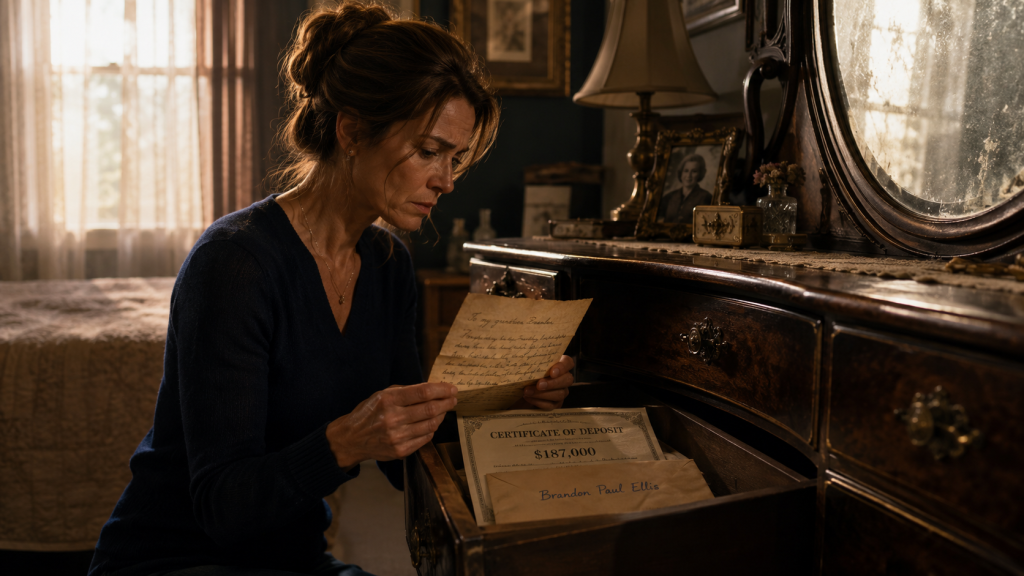
It was a manila envelope.

Old.

Yellowed.

Sealed with brittle tape.

Across the front, written in fading blue ink, was Brandon’s full name.

Brandon Paul Ellis.

For a moment, I simply stared.

Then I sat down on the floor with the envelope in my lap.

I considered calling him.

That instinct disappeared almost immediately.

Brandon had laughed when I took the vanity.

He had said nobody wanted it.

He had signed the divorce agreement giving it to me.

Whatever this was, it had been hidden for years.

With trembling hands, I opened it.

Inside was a handwritten letter and a bank certificate.

The certificate was dated nineteen years earlier.

My eyes moved across the page slowly.

Deposit amount: $187,000.

I read it again.

Then a third time.

My hands went cold.

There had to be a mistake.

I unfolded the letter.

The handwriting was Evelyn’s.

Careful.

Elegant.

Slightly slanted.

To my grandson Brandon,

If you are reading this, it means you found what I hid.

I hope that means you became the kind of man patient enough to look beyond appearances.

I pressed a hand over my mouth.

The letter continued.

I have watched money ruin better people than you. I have also watched pride make fools of men who believed they were smarter than love. This certificate represents savings, investments, and family money I kept separate because I wanted it to go to someone who understood responsibility.

I know your weaknesses, Brandon. I love you, but love does not require blindness.

You can be charming when you want something. You can be cruel when you feel denied. You take winning too seriously and kindness not seriously enough.

I hope time changes you.

If it does, this money may help you build a good life.

If it does not, then perhaps life itself will decide where this gift belongs.

My throat tightened.

There was another page.

This one was addressed differently.

To whoever finds this,

If Brandon gave this vanity away, sold it, abandoned it, or mocked it without ever caring enough to discover what was hidden inside, then let that be his answer.

He had a choice.

People reveal themselves by what they value.

I leave this certificate to the person who kept this old vanity not for its beauty, but because it meant something.

Use it with more wisdom than greed would have allowed.

Evelyn

I sat on the floor for a long time.

The house was completely silent except for the hum of the refrigerator down the hall.

The afternoon light stretched across the carpet.

Dust floated in the beam from the window.

I stared at Evelyn’s signature until my eyes filled with tears.

Not because of the money.

Not at first.

Because she had seen him.

She had seen me too.

All those years when I thought I was quietly enduring a family that never fully accepted me, Evelyn had been watching.

She had known.

I called my friend Tessa, who worked at a law office.

My voice shook so badly she could barely understand me.

“Slow down,” she said. “What did you find?”

“A bank certificate. In Brandon’s grandmother’s vanity.”

“How much?”

I told her.

There was a long silence.

Then she said, “Do not call Brandon.”

“I wasn’t going to.”

“Good. Put everything in a plastic folder. Take photos. Bring it to an attorney.”

The next morning, I met with a probate attorney named Mr. Alvarez.

He read the letter twice.

Then he examined the certificate.

“This is unusual,” he said.

“That sounds bad.”

“Not bad. Complicated.”

“Can he take it?”

Mr. Alvarez leaned back.

“The vanity was awarded to you in the divorce?”

“Yes.”

“Do you have the agreement?”

I handed it over.

He read the section.

Personal property retained by petitioner includes antique vanity from Ellis estate.

He nodded.

“And the envelope was inside it at the time?”

“Yes.”

“Hidden?”

“Taped behind a drawer.”

He looked at Evelyn’s letter again.

“The language is clear in intent, but we need to verify the certificate, determine whether the funds still exist, and establish whether this was a valid gift or part of her estate.”

My heart sank.

“So I may not get it.”

“You may,” he said. “But expect resistance if your ex-husband learns about it.”

I almost laughed.

“Resistance is Brandon’s favorite hobby.”

The bank confirmed the certificate was real.

The funds had been rolled into an account after the original bank merged twice.

With interest and reinvestment, the amount had grown.

A lot.

By the time Mr. Alvarez called me with the number, I had to sit down.

“Approximately $312,000,” he said.

I stared at the wall.

“That can’t be right.”

“It is.”

I cried after I hung up.

Full, ugly crying.

The kind that bends your body forward and makes you sound like someone else.

For a year, I had counted every dollar.

I had skipped dental appointments.

Bought secondhand clothes.

Eaten toast for dinner.

Meanwhile Brandon had fought me for things he barely cared about, just to make sure I left with less.

And the one thing he mocked had held more value than everything he won.

I did not tell him.

But secrets have a way of becoming rumors.

Two weeks later, Brandon called from a blocked number.

I should not have answered.

“Did you find something in Grandma’s vanity?” he demanded.

My stomach dropped.

“Hello to you too.”

“Don’t play stupid, Claire.”

There it was.

That tone.

The one that used to shrink me.

Only now it sounded smaller over the phone.

“I don’t know what you’re talking about,” I said.

“My mother heard from Aunt Linda that some lawyer called about Grandma’s estate.”

“Then ask your mother.”

“That vanity was mine.”

“No,” I said calmly. “You gave it to me in the divorce.”

“I didn’t know there was money in it.”

“That seems to be the point.”

He went silent.

Then exploded.

“You stole from me.”

I laughed once, quietly.

For years, I would have apologized just to calm him down.

Not anymore.

“You fought me for the camper we used twice,” I said. “You fought me for a grill with one working burner. You fought me for Christmas ornaments. Then you laughed and told me nobody wanted the vanity.”

“It was my grandmother’s.”

“And she left a letter explaining exactly what she thought of that.”

His breathing changed.

“What letter?”

I hung up.

That evening, he showed up at my rental house.

I saw him through the peephole.

Same expensive jacket.

Same angry eyes.

I opened the door with the chain on.

“You need to leave.”

“That money belongs to me.”

“No, Brandon. You believed everything belonged to you. That was always the problem.”

He pointed at me through the gap.

“You think you won?”

I looked at him.

Really looked.

At the man who had taken the house, the cars, the camper, the furniture, and still stood on my porch furious because I might have something he did not.

“No,” I said. “I think I’m finally done playing.”

He threatened court.

Of course he did.

His lawyer sent a letter.

Mr. Alvarez responded with the divorce agreement, the photos, Evelyn’s handwritten note, and a legal argument strong enough to make the threats disappear within a month.

Brandon did not apologize.

Men like him rarely do.

But he stopped calling.

The money was released six months later.

I did not buy a sports car.

I did not post online.

I did not throw a party.

First, I fixed my teeth.

Then I paid off debt.

Then I bought the little rental house from my landlord, who cried when I told her I wanted to stay.

I restored Evelyn’s vanity.

Not cheaply.

Properly.

The cloudy mirror was carefully cleaned, not replaced.

The scratches were softened but not erased.

I wanted it to keep its history.

When the restorer finished, the dark wood glowed like it had been waiting years for someone to see it properly.

I placed it in my bedroom by the window.

On top of it, I keep Evelyn’s letter in a frame.

Not the part about the money.

The part that says:

People reveal themselves by what they value.

Sometimes I sit there in the morning, brushing my hair in that old mirror, and I think about how strange life is.

Brandon fought for everything shiny, useful, and easy to brag about.

The house.

The cars.

The camper.

The things people could see from the street.

He laughed at the ugly old vanity because he thought it had no value.

He did the same thing to me.

For years, he looked at me and saw something ordinary.

Something he could criticize, dismiss, or leave behind.

He never wondered what I carried inside.

Patience.

Loyalty.

Strength.

The ability to begin again.

That was his mistake.

The vanity taught me something I will never forget.

Not every treasure looks like treasure at first.

Some are heavy.

Old.

Clouded.

Ignored.

Some sit in spare rooms collecting laundry while life teaches you how to stand up straight again.

And sometimes, when you finally stop trying to sell what the world called ugly, you discover it was the only thing worth keeping all along.

THE END! THANKS FOR READING!

Related Posts